

MetaClaw
A tool that lets a coding or chat agent learn and improve from ordinary conversations over time, through skill extraction, reinforcement learning and persisted cross-session memory.
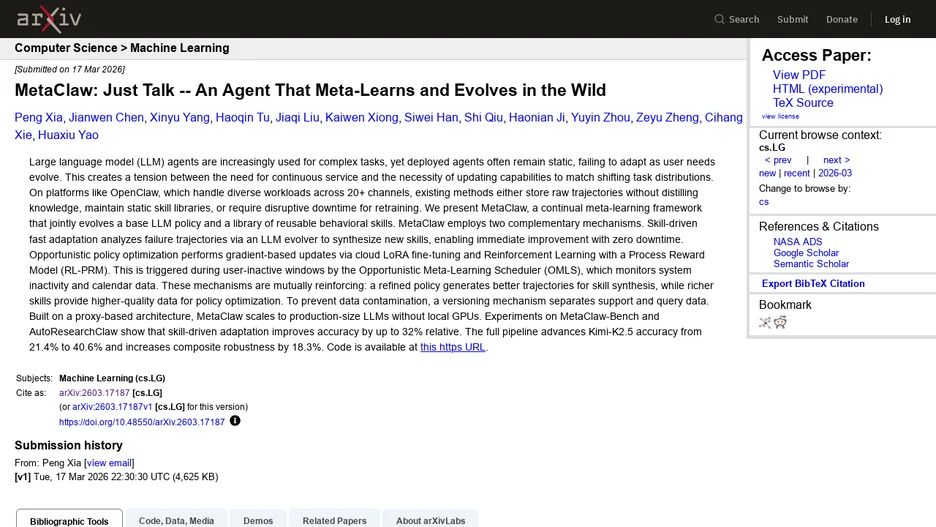
MetaClaw is a meta-learning layer for AI agents such as OpenClaw that lets them improve from everyday conversations instead of needing a GPU-heavy retraining pipeline. It runs in a skills-only mode, a reinforcement-learning mode that trains on batches of past interactions, or an automatic mode that combines both on a schedule.
A memory layer, called the Contexture layer, persists facts, preferences and project history across sessions and automatically retrieves and injects them into future prompts, with adaptive memory policy and background consolidation. Continual learning support runs slow reinforcement-learning updates only during idle time, sleep hours or scheduled gaps, and separates support and query sets to avoid stale reward signals. It supports multiple backends, including Tinker and MinT, and can connect to several agent harnesses in addition to OpenClaw.
It is written in Python and released under the MIT license.