

Microsoft Agent Framework
An open, multi-language framework for building and orchestrating production-grade AI agents and multi-agent workflows in Python, .NET and Go, with graph-based orchestration patterns and Foundry-hosted deployment.
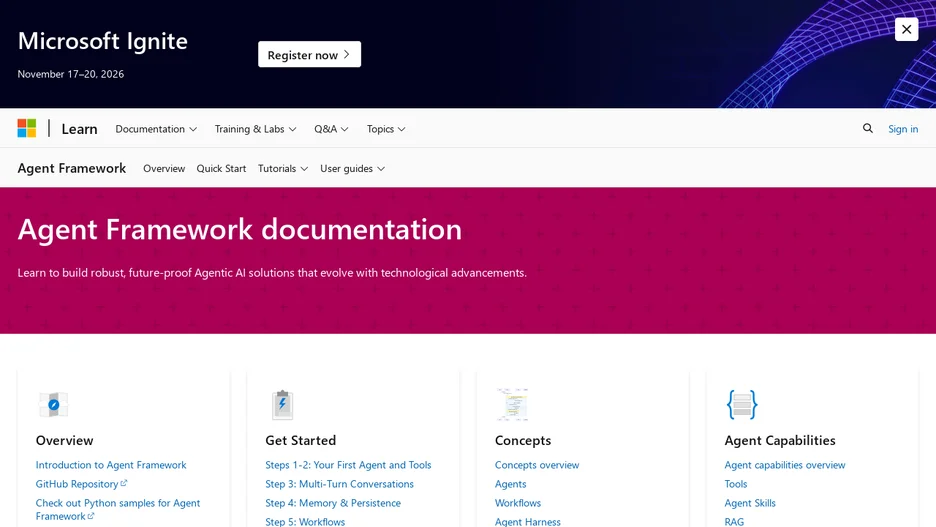
Microsoft Agent Framework is an open, multi-language framework for building production-grade AI agents and multi-agent workflows in Python, .NET and Go, aimed at teams moving agents from a prototype into production. It gives a consistent foundation for building, orchestrating and operating agent systems while keeping architecture choices open, and supports an ecosystem that includes Microsoft Foundry, Azure OpenAI, OpenAI and the GitHub Copilot SDK.
It supports orchestration beyond a single prompt or a stateless chat loop, with graph-based patterns for sequential, concurrent, handoff and group-collaboration workflows, including checkpointing, streaming, human-in-the-loop control and the ability to step backward through a run. A flexible middleware system handles request and response processing, exception handling and custom pipelines, and agents can be deployed to Foundry-hosted infrastructure with a small code change.
It targets teams that care about durability, restartability, observability, governance and provider flexibility, so an architecture can evolve without a rewrite as requirements change.