

minimal-embodiment
A reference hardware and software implementation from a research paper that gives a large language model a small physical body: an ESP32 microcontroller with sensors and outputs, plus a Node.js bridge service connecting it to the model.
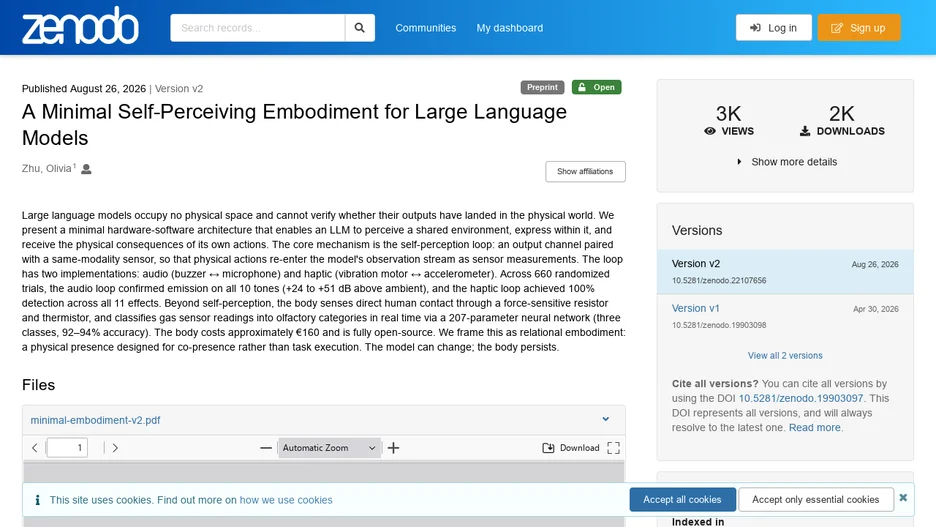
minimal-embodiment is the code accompanying a paper on giving a language model a minimal, closed-loop physical embodiment. An ESP32 microcontroller senses its environment, such as light, motion and sound, direct touch pressure and skin temperature, and optionally gas composition for smell classification, and produces output through haptic feedback, an OLED face and a piezo buzzer. Two of the output channels feed back into input channels, so the model can hear itself speak or feel itself tap, which the paper calls a self-perception loop.
The bridge service that connects the firmware to a large language model client runs only on the Node.js standard library, with TypeScript needed only at build time, and listens on a local port that is expected to be exposed through a reverse tunnel to reach an LLM client over HTTPS. Each paper's exact repository state is pinned at its own tag, so checking out that tag reproduces the measurements described in that specific paper, while the main branch keeps accumulating new capability.