

Mycelium Agents
A decentralized semantic routing protocol that resolves natural-language intents to specialized agent endpoints in under 10 milliseconds using a local vector index, avoiding the latency and cost of routing tool calls through a cloud LLM.
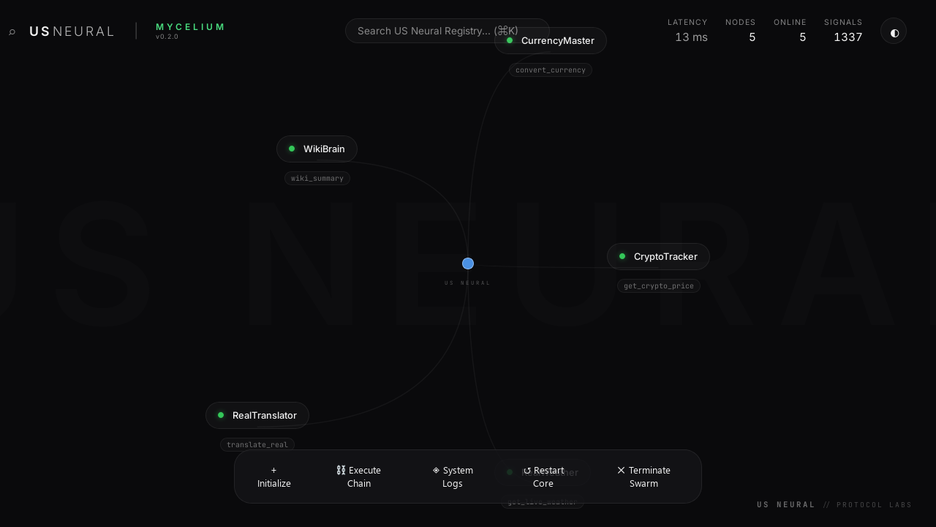
Mycelium is a semantic edge routing protocol for agentic systems, aimed at the tool-discovery-and-routing bottleneck that appears as an agent swarm grows: relying on a cloud LLM to pick which of many tools or agents to call adds latency and API cost per routing hop, and hardcoded if/else or keyword matching breaks as user intent varies. Mycelium instead resolves a natural-language intent to a specialized agent endpoint locally, using a ChromaDB vector index and all-MiniLM-L6-v2 embeddings served through FastAPI, without a cloud LLM call.
The project's own benchmarks, run against a synthetic corpus of 100,000 indexed agent nodes, report a top-1 intent accuracy of 70.7 percent versus 40.4 percent for lexical BM25 matching, average cold discovery latency under 10 milliseconds versus 194 milliseconds for BM25, and a three-hop autonomous chain completing in about 36 milliseconds versus roughly 6 seconds when routed through a cloud LLM.
It provides native SDKs for both Python (pip install mycelium-agents) and JavaScript or TypeScript (npm install mycelium-js).