

nanobot
nanobot is an ultra-lightweight, self-hosted personal AI agent framework in Python that runs in a browser WebUI, a terminal, or chat apps, combining tools, long-term memory, MCP and multi-agent delegation in a small core.
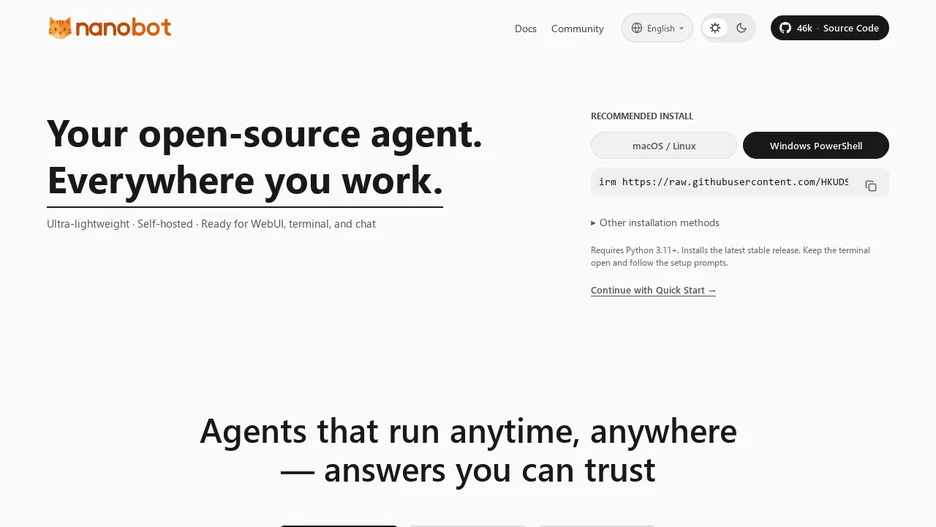
It connects to Telegram, Discord, Slack, WeChat, email, Mattermost, Linear and other channels, and gives an agent tools such as files, shell access, web search, web fetch, MCP, cron scheduling, image generation and delegation to subagents, plus long-term memory through a feature called Dream. It can run long-horizon goals and scheduled automations on its own, and exposes both a Python SDK and an OpenAI-compatible API for embedding into other software.
A stable track installs from a released package and updates the same way, while an editable source-checkout track tracks the newest, less-tested changes; published packages include the WebUI, and supported-platform wheels also include a native TUI.
Requires Python 3.11 or newer. MIT licensed.