

Network-AI
A TypeScript and Node.js multi-agent orchestrator that adds a shared, lockable blackboard, budgets and guardrails to coordinate parallel agents across 32 different agent frameworks.
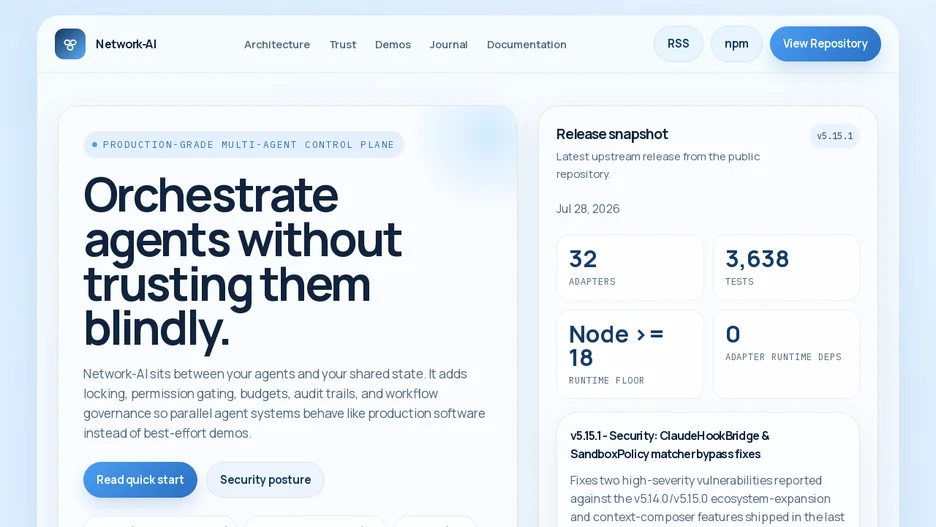
Network-AI coordinates multiple AI agents that would otherwise write to shared state independently, using a blackboard with atomic propose, validate and commit steps to prevent race conditions and split-brain failures when parallel agents disagree about the same piece of state. Guardrails add a finite-state-machine governance layer, per-agent token ceilings, cryptographically signed audit trails and permission gating.
It ships 32 adapters, including LangChain, AutoGen, CrewAI, the OpenAI Assistants and Responses APIs, LlamaIndex, Semantic Kernel, Haystack, DSPy, MCP, LangGraph, the Claude Agent SDK, the OpenAI Agents SDK, Vertex AI, Gemini, Pydantic AI and a generic adapter for other Recursive-Language-Model-compatible endpoints, so an existing agent stack can plug in without glue code. A context composer assembles token-budgeted, relevance-ranked context packs instead of dumping an entire shared blackboard into an agent's window, and a persistent project-memory layer injects decisions, goals, stack choices, milestones and banned patterns into every system prompt.
Other modules include session record-and-replay, a comparison runner, a coverage reporter, a job queue, gRPC and HTTP transport, and a governed model gateway that manages fallback, repricing and thinking-block handoff behind one budgeted, audited call. It is written in TypeScript for Node.js.