

Neuronto ARD Registry
A federated search index over Agentic Resource Discovery registries, letting an AI agent find MCP servers, APIs, skills and other tools by query instead of being wired to each one in advance.
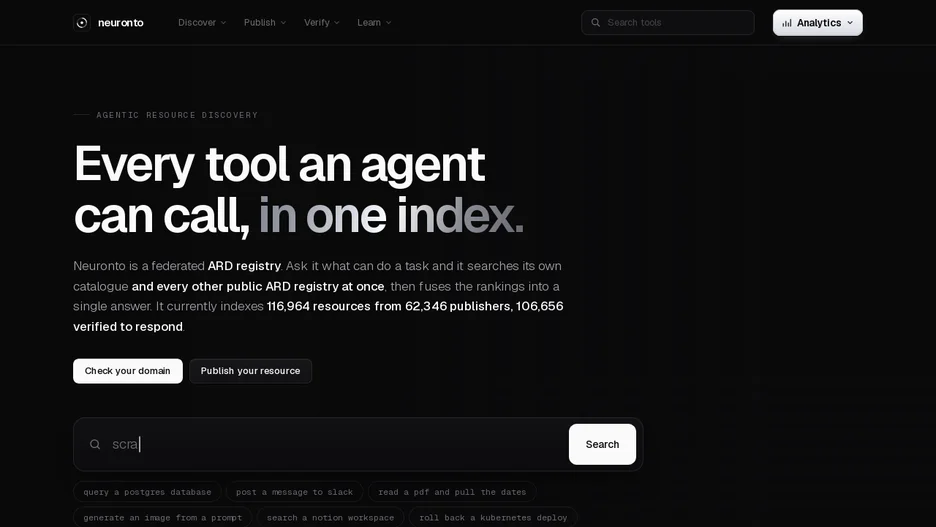
Neuronto is a registry and search index for Agentic Resource Discovery, an open specification published in 2026 by a working group that includes Google, Microsoft, Hugging Face and AWS, for how AI agents find the tools, skills, agents and APIs they need. An agentic resource is anything an AI client can call to get work done, and the specification only answers what is available for a task, leaving the agent to connect using that resource's own protocol, such as MCP or agent-to-agent.
Because each public registry today only answers from its own catalogue, a query asked in different places returns different results. Neuronto acts as both a publisher, describing what it offers, and a federated registry that fans a query out to every public registry at once and fuses the results with reciprocal rank fusion, reporting which registries answered and which timed out. It also verifies what an indexed MCP server actually exposes by reading its own tool list, and publishes a benchmark and dataset for the approach.