

Nexus Agent
Nexus Agent is a Chinese-language enterprise AI agent platform combining conversational chat, document question-answering, web search, retrieval-augmented generation, MCP tool calling and skills extensions behind a layered execution architecture.
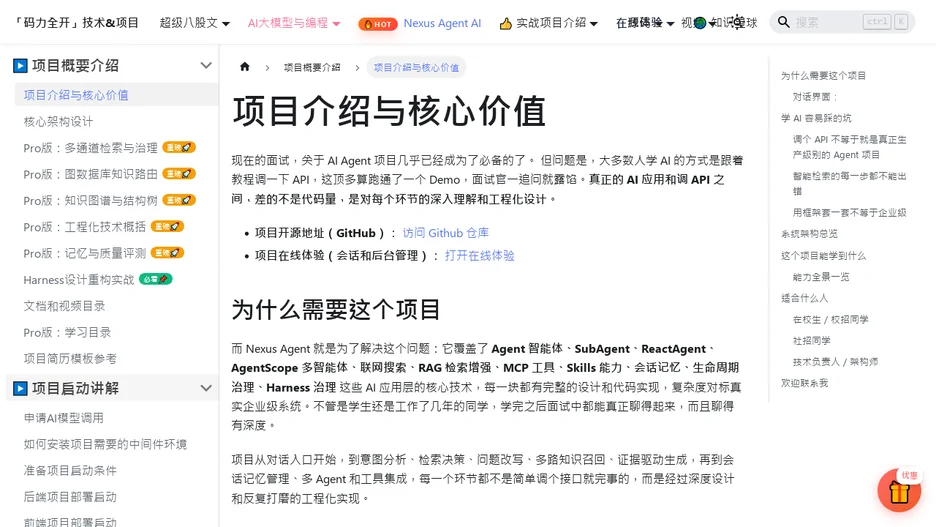
Nexus Agent is an enterprise conversational AI platform that routes each request through a three-layer executor: deterministic orchestration first, then a choice between clarifying the question, answering from indexed knowledge, or handing off to an open-ended agent loop. Documents are parsed with Apache Tika, chunked with a combination of structural, recursive, semantic and LLM-based strategies, then indexed into both a vector store and an inverted index, with a Neo4j graph of document, section and item structure for navigation.
Retrieval combines vector and keyword search with reciprocal rank fusion and an optional external reranker, budgets and short-circuits when no evidence is found, and aggregates small retrieval chunks back into larger ones for the final answer. Conversation memory can run with no memory, a sliding window, or summarized compression, and results stream over Server-Sent Events with follow-up question suggestions.
It is built in Java on Spring AI, and stores data in MySQL, PGVector, Elasticsearch, Neo4j, Redis, Kafka and MinIO.