

Octop
A self-hosted, multi-user, multi-agent AI assistant that runs entirely on a user's own machine, aiming to give teams, families and individuals an independent, collaborative agent environment.
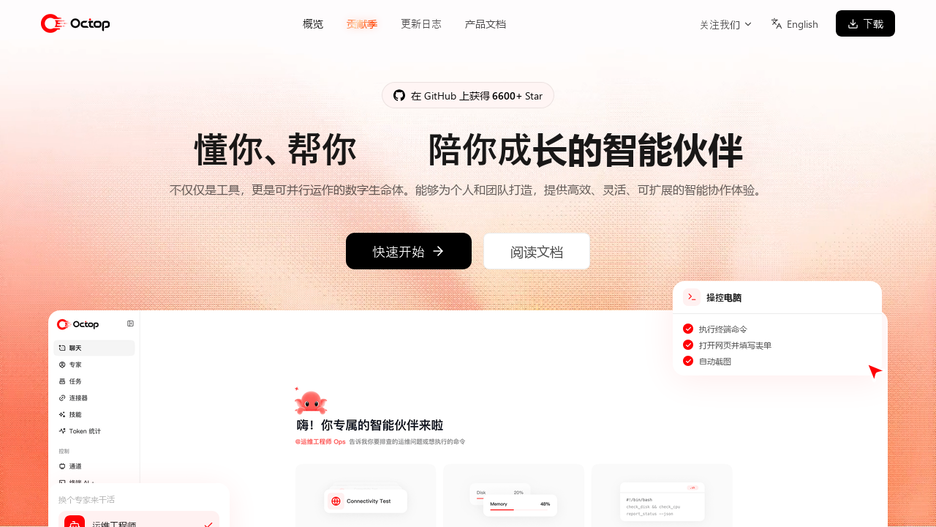
Octop is reachable through a web dashboard, Feishu, DingTalk, QQ, WeChat, Telegram, Discord, WeCom, or programmatic HTTP, SSE or WebSocket access, with capabilities extended by an expert library, OAuth and MCP connectors, and ACP integration for IDE workflows.
It offers a shared multi-user expert team with an expert library and market, expert sharing so teammates reuse skill and sub-agent pools, sixteen MBTI-style personality templates, a beta coordinator for scheduling multiple experts on multi-step work, JWT multi-user isolation with tool approval and shell guardrails, pluggable workspace backends (local disk, Docker sandbox, PostgreSQL, or COS/S3), a portable memory system, retrieval-augmented generation over shared knowledge bases, third-party plugins, and bidirectional ACP so it can delegate to OpenCode or Claude Code with permission gates.
It is written in Python and licensed under AGPL-3.0.