

OMA
A self-hosted TypeScript agent runtime where consequential actions wait for durable, tamper-evident approval and every run leaves an offline-verifiable record.
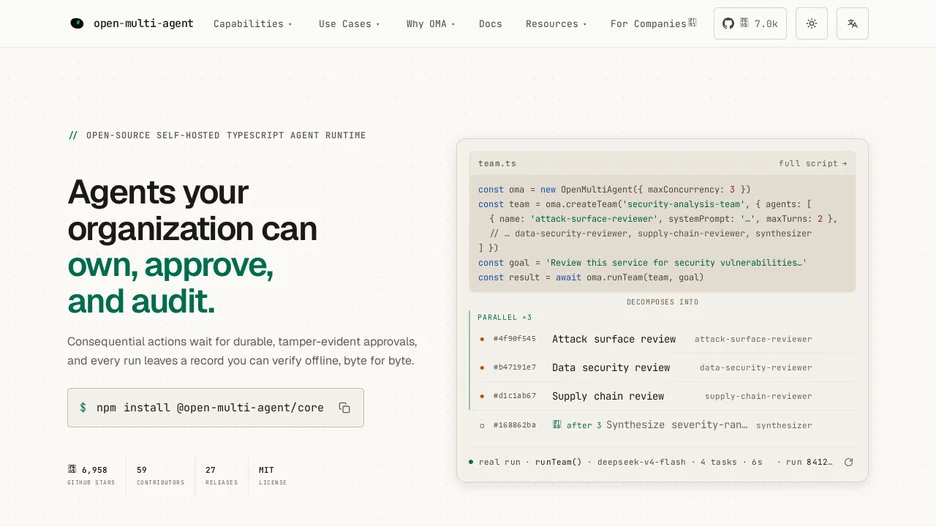
OMA (Open Multi-Agent) lets an organization run its own agents rather than depend on a hosted control plane, connecting to cloud or local models such as Ollama, vLLM, or llama-server. A plan, task dispatch, or tool call can suspend for approval; the request is stored with the checkpoint, bound to a hash of exactly what the reviewer saw, and the run resumes from that content after a restart, with a decision that is atomic and first-wins.
A journal backend records every block the model saw, every tool call and result, and every context rewrite, and a verification function reads that journal back offline and checks that each recorded event matches its named source.
OMA runs single agents, explicit task pipelines, or goal-driven teams, and is written in TypeScript under the MIT license.