

OpenDecision
An open-source Python package that answers typed questions about application state or documents using a local natural-language-inference model, returning structured choice, score, yes/no or evidence-relation values instead of free text.
OpenDecision is a Python package that answers typed questions about application state or documents by running a local natural-language-inference model and returning structured values rather than generated text. It supports several question types: choice, which selects one supplied option and returns its probability; noul, which scores one statement from zero to one; score, which places an answer on a supplied ordered scale; relation, which compares a piece of evidence with a statement and its opposite and returns whether it supports, contradicts or is unknown or conflicted; and a document-decision mode that answers questions about a longer text or a JSON document with source passages attached.
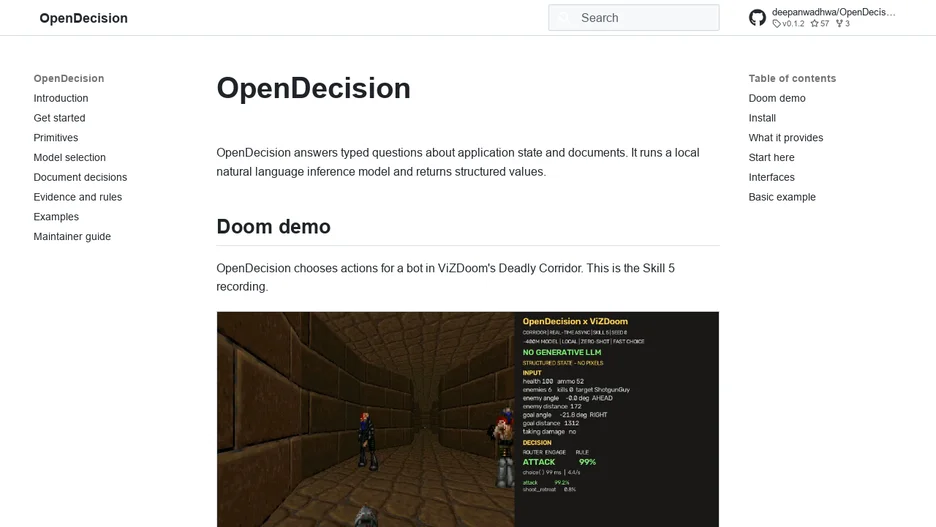
It is installed as a Python package and used directly in the same process as the calling application, or run as a local HTTP API with endpoints for typed questions and document decisions, including an endpoint compatible with TypeSafe's software development kit. The project also publishes a demonstration in which OpenDecision chooses actions for a bot playing a level of the game Doom, as an example of the engine making real-time structured decisions rather than generating text.