

OpenGAP
A git-native, framework-agnostic standard for defining an AI agent so that cloning a repository is enough to get a portable, version-controlled agent.
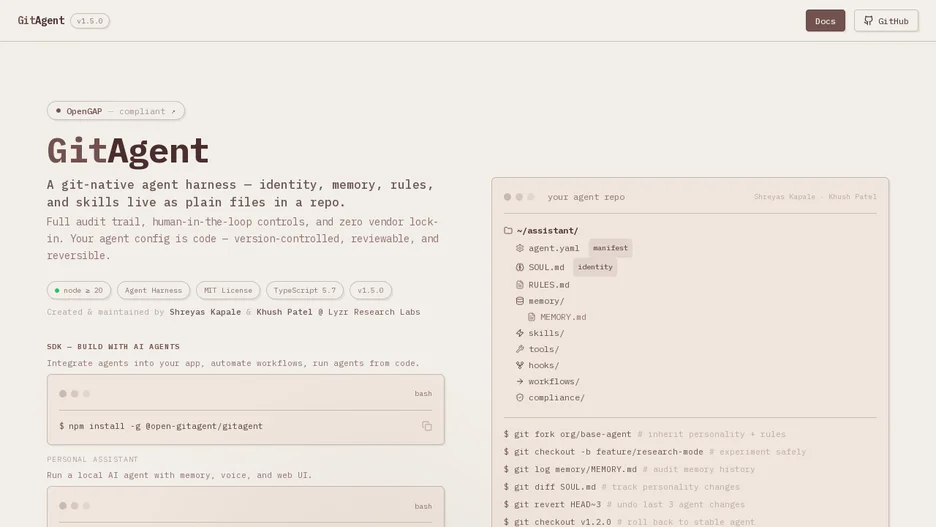
OpenGAP, the Git Agent Protocol, is a framework-agnostic standard for defining AI agents as ordinary git repositories, so cloning a repository yields a working, portable agent. Its reference command-line tool is published as opengap, and the project was previously known under two other names; an older command remains as a backward-compatible alias.
Only two files are required to define an agent: a manifest and an identity file, with everything else optional. Because agents are git repositories, version control, branching, diffing, and pull-request review apply directly, enabling patterns such as human review before a learned skill is merged, segregation-of-duties roles validated automatically, a shared memory folder for live state, and shared context and skills across every agent in a monorepo.
It is written in TypeScript and released under the MIT license.