

OpenMetadata
An open platform that builds a unified metadata knowledge graph across an organization's data, connecting lineage, ownership, quality, glossaries and data contracts so both people and AI agents can discover, trust and use data correctly.
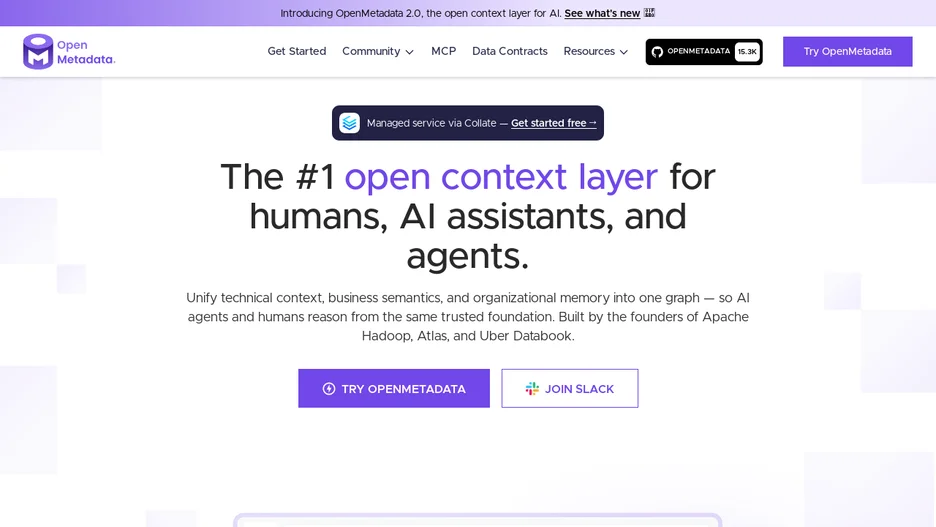
OpenMetadata is an open platform for data cataloging and metadata management that gives data users and AI agents a shared, governed context for an organization's data. It connects technical metadata, data quality signals, lineage down to the column level, ownership, usage, policies, glossaries, classifications, metrics, domains, data contracts and data products into a single metadata knowledge graph.
It ships with more than 130 connectors to data sources, open metadata standards, semantic search, APIs and SDKs, and an MCP server so an AI assistant or agent can query what data exists, what it means, who owns it, where it came from, whether it is trusted, and what depends on it, instead of connecting directly to raw data with no context.
Its capabilities are organized around context (technical, operational, trust, usage and lineage metadata), semantics (business meaning through glossaries, metrics and ontologies), a knowledge graph linking assets, people and policies together, and memory of past conversations and decisions about the data. It is written in TypeScript and released under the Apache 2.0 license.