

OxyGent
A Python multi-agent framework that unifies tools, models and agents into modular, hot-swappable Oxy components, with dynamic task decomposition, auditable agent negotiation, and a distributed scheduler for scaling agent systems.
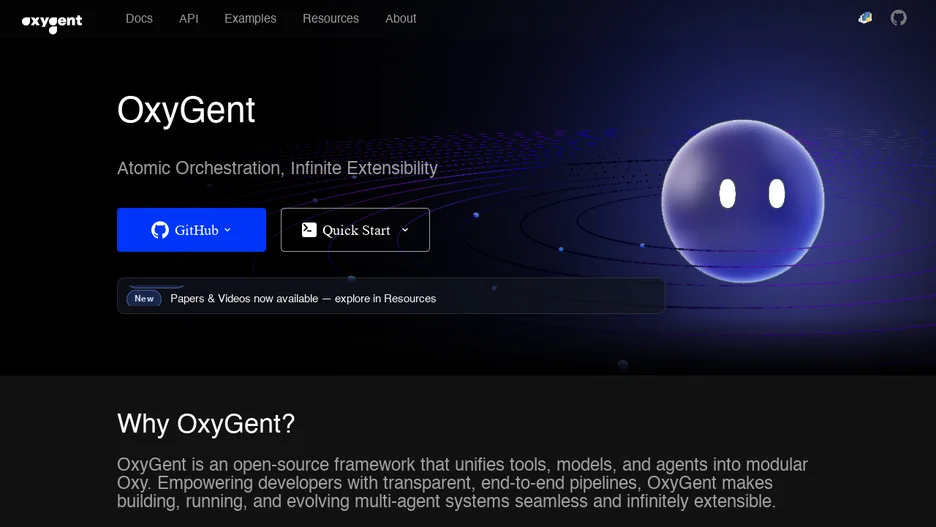
OxyGent is an open-source Python framework for building multi-agent systems out of a single modular abstraction called Oxy, which wraps tools, models and agents into interchangeable components that can be assembled, hot-swapped and reused across scenarios through a plain Python interface rather than configuration files.
Its agents dynamically decompose tasks, negotiate between themselves and adapt to changes at runtime rather than following a fixed workflow, while keeping every decision auditable, and the underlying architecture supports agent topologies ranging from simple ReAct loops to complex hybrid planning, with automated dependency mapping and visual debugging tools. Built-in evaluation engines turn each run into training data so agents can improve over time, and a distributed scheduler is designed to keep cost growth roughly linear as more agents and interactions are added.
The project reports a score of 59.14 on the GAIA benchmark, close to the leading open-source multi-agent system at the time. It is released with both Python and Java open-source implementations.