

PhoneClaw
A local AI agent framework that turns a phone into an on-device agent runtime, running small vision-language models directly on the device and calling native mobile skills such as Calendar, Reminders, and Health.
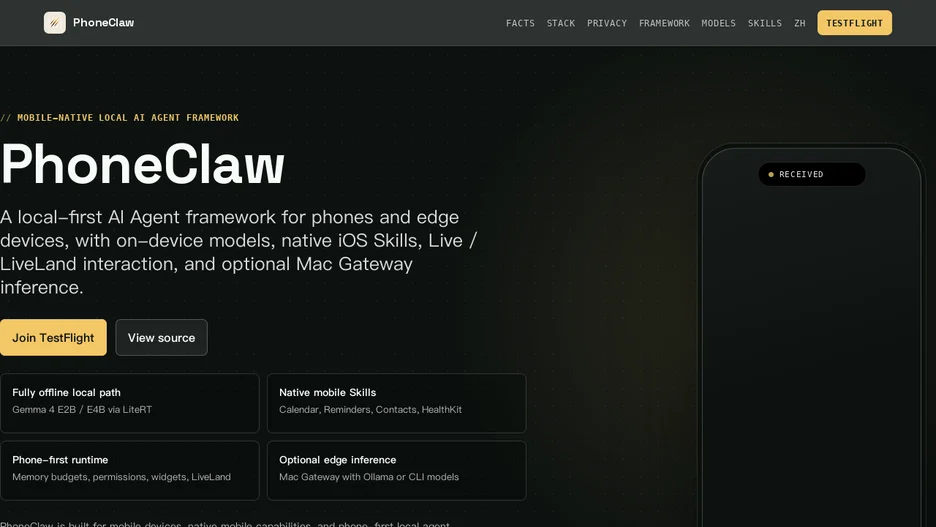
PhoneClaw is a local AI agent framework for phones and edge devices. It runs small models, Gemma 4 E2B and E4B through LiteRT and MiniCPM-V 4.6, directly on the device, and uses native mobile Skills for Calendar, Reminders, Contacts, Clipboard, Health data, image understanding, and voice, letting a user explicitly opt into web search, webpage reading, or LAN-based inference from a paired Mac when a task needs more than the on-device model can do.
A feature called LiveLand surfaces the agent from the iOS Dynamic Island, Home Screen or Lock Screen widgets, Shortcuts, or Control Center: the agent listens, understands the request, runs the task, and shows the result in place, with visible progress as it receives, understands, and executes a command; it runs on local models by default with a fully offline path and no per-call token billing, and unclear or risky actions such as ambiguous times, deletes, or bulk operations ask for confirmation first.
A companion Mac Gateway app can be paired over the local network to use Mac-side Ollama, Codex CLI, or Antigravity CLI as a remote inference source. It is written in Swift.