

Porrima
A self-hosted, memory-native AI agent framework with a cross-platform app GUI, designed to run continuously and build up its own long-term memory over time.
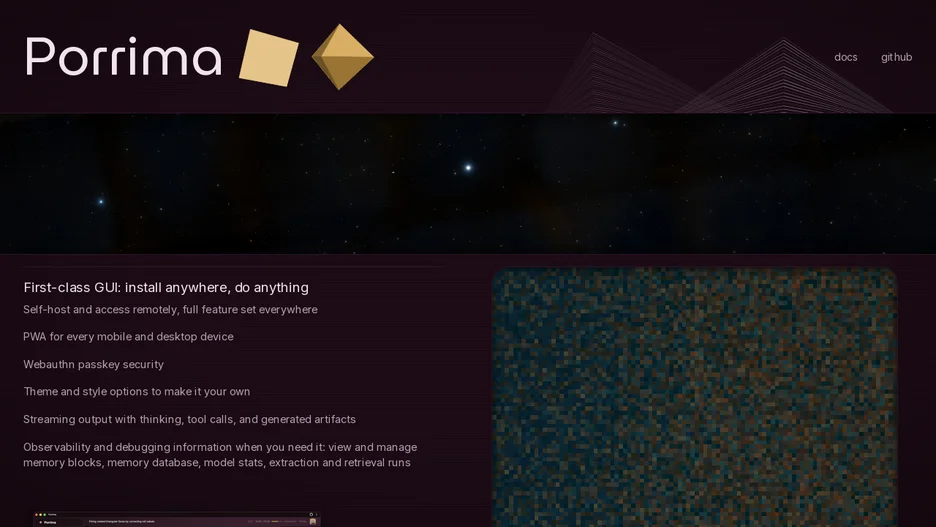
Porrima's client is a progressive web app for desktop, tablet and mobile, reachable remotely through Cloudflare Tunnels and secured with WebAuthn passkeys, with push notifications, full-text chat search and project-scoped chat organization. It runs two language models and a reranker at once, using both GPU and CPU on a typical high-end desktop.
A memory-extraction model takes two passes over each conversation in the background, recording new atomic memories with dense-vector embeddings and marking outdated ones as superseded for later subconscious recall, while the main model periodically reviews recent memories and folds them into self-managed memory blocks scoped globally or per project, including a default running-summary block, plus topical blocks it creates on its own.
Five managed llama.cpp server instances, covering main chat, memory extraction, title generation, reranking and embeddings, are configurable from a settings menu with any mainline or forked llama.cpp binary and any GGUF model, and the agent can hot-swap its own llama.cpp process without user intervention. It exposes detailed observability into memory blocks, the memory database, model stats and the constructed system prompt.