

PraisonAI
A multi-agent framework for building autonomous agents that research, plan, code and execute tasks, with a five-layer stack covering prompts, context, tools, execution loop and deployment.
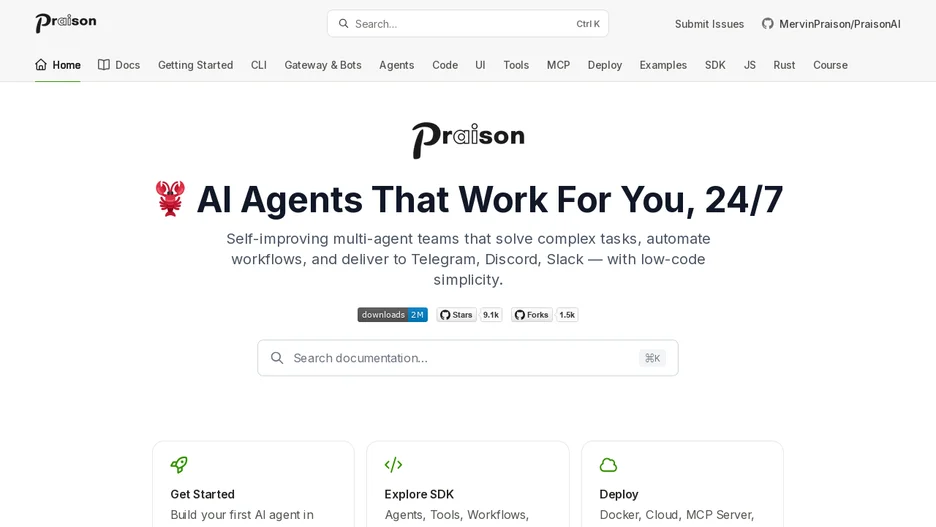
PraisonAI is a framework for building autonomous, self-improving AI agents that research, plan and execute tasks across an application, ranging from a single agent to a whole organization of them. A lightweight core SDK creates an agent from a short Python script by giving it instructions and a goal.
The framework organizes an agent around five layers: prompt (instructions, role, goal, backstory, output format and templates), context (memory, knowledge, context and handoff policy), harness (tools, MCP connections, guardrails, approval, hooks and sandboxing), an execution loop (execution configuration, reflection and autonomy settings), and an outer layer that decides where the agent runs; each layer wraps the one inside it, so a misbehaving agent can be traced to the layer responsible.
It supports more than 100 LLMs, built-in memory and retrieval-augmented generation, and is used for tasks such as research and analysis, code generation, content creation, data pipelines, customer support bots on platforms like Telegram, Discord and Slack, and workflow automation. It is written in Python under the MIT license.