

ProbOS
An experimental operating-system-styled runtime in which every component is an autonomous agent: natural language replaces syscalls, Hebbian-learning-based attention replaces the scheduler, and destructive operations require multi-agent consensus instead of file permissions.
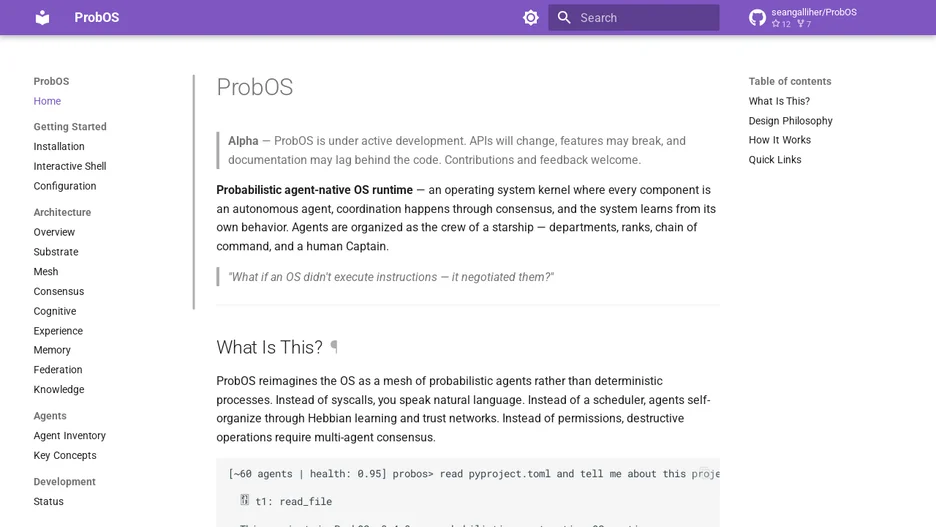
ProbOS reimagines an operating system as a mesh of probabilistic, self-organizing agents rather than deterministic processes: instead of syscalls it takes natural language, instead of a scheduler agents self-organize through Hebbian learning and trust networks, and destructive operations require multi-agent consensus instead of permission checks.
It replaces traditional OS mechanisms one for one: intent DAGs decomposed from natural language instead of syscalls, attention-based priority scoring instead of a process scheduler, multi-agent consensus voting with red-team verification instead of access control lists, an agent registry with health monitoring instead of a process table, a pub/sub intent bus instead of inter-process communication, an offline dreaming consolidation engine instead of cron, episodic memory with semantic recall instead of command history, and a learned workflow cache instead of shell aliases. Every agent keeps a confidence score and trust reputation.
Built with Python. Apache-2.0 licensed. The project is in alpha, with APIs, features and documentation still in flux.