

Recommenders
Jupyter notebook examples and best practices for building, evaluating and productionizing recommendation systems, maintained under the Linux Foundation.
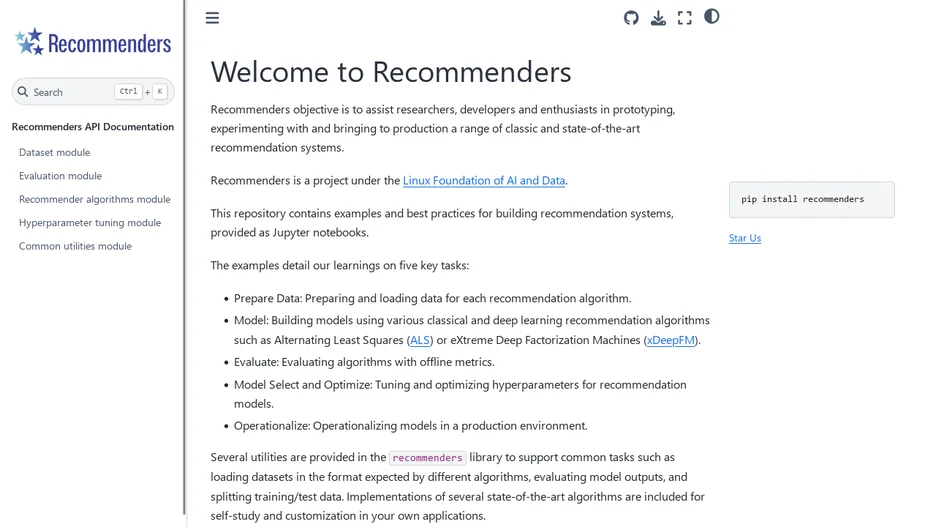
Recommenders is a project under the Linux Foundation of AI and Data that provides examples and best practices, as Jupyter notebooks, for prototyping, experimenting with and bringing recommendation systems into production. It aims to assist researchers, developers and enthusiasts across five tasks: preparing and loading data for a given algorithm, building models with classical and deep-learning recommendation algorithms such as Alternating Least Squares or extreme deep factorization machines, evaluating algorithms with offline metrics, tuning and optimizing hyperparameters, and operationalizing a model in production, with an Azure-focused example.
Utilities included in the project cover common tasks such as loading datasets in the format each algorithm expects, evaluating model outputs and splitting data into training and test sets, and implementations of several state-of-the-art algorithms are included for self-study and for customizing in a reader's own application.
The project recommends uv for environment management and Visual Studio Code for development, and documents optional GPU and Spark extras for running those classes of models.