

secchi
A terminal tool for exploring, comparing, monitoring and reporting on open-source package health, adoption, dependencies, releases and security advisories across ecosystems such as PyPI, npm, crates.io and Go modules.
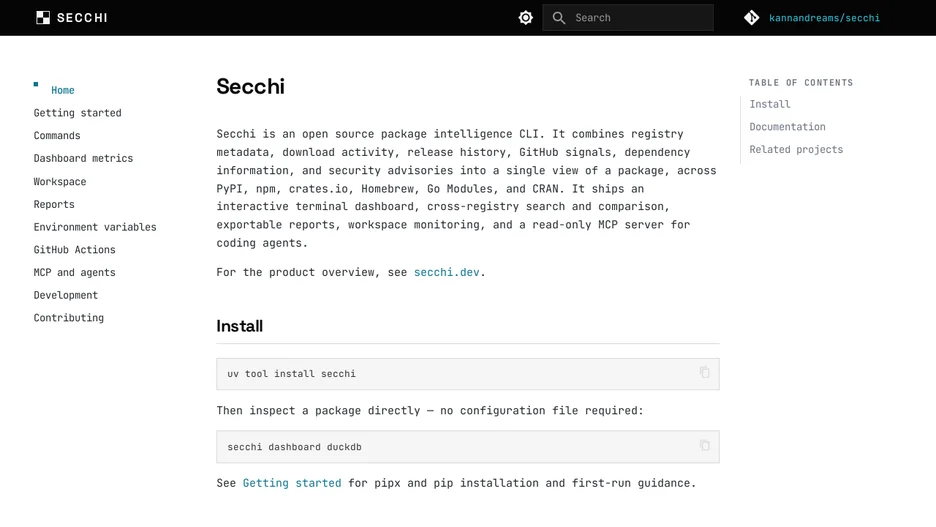
secchi lets you inspect package health, adoption, dependency, release and ecosystem signals from the terminal, across PyPI, npm, crates.io, Homebrew, Go modules, CRAN and pub.dev. It can be tried without installing, using uvx to run a temporary environment, with commands to print package intelligence or open an interactive dashboard.
Capabilities include direct package lookup, an interactive dashboard, monitoring of configured workspace projects, cross-registry search, health and adoption signals, OSV security advisories for the latest version, and package comparison that ranks choices using health, adoption and confidence evidence. Results can be exported as JSON for scripts and automation, or as Markdown and HTML reports for sharing.
A workspace configuration, created with an init command, is only needed for monitoring your own projects; direct package exploration works without it. It checks PyPI at most once a day for a newer release.