

Simplex
A semi-structured specification format, now at version 0.6, for describing work assignments for autonomous agents: a document states required behavior, completion criteria, examples and failure handling, checked by a deterministic Go linter.
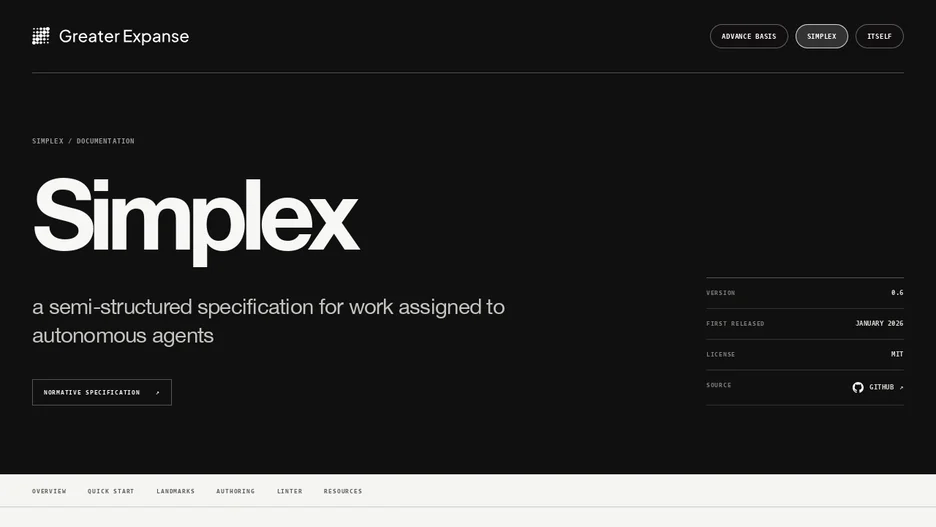
Simplex is a specification language for describing what an autonomous agent must do without dictating how, so the agent keeps freedom over implementation while the assignment stays checkable. A Simplex document defines one or more functions, each requiring a RULES section stating required behavior, a DONE_WHEN section stating completion criteria, EXAMPLES, and ERRORS describing failure handling; optional elements include stable identifiers and a COVERS section mapping examples back to the rules and criteria they demonstrate.
The repository holds the normative specification itself, four example .simplex documents, and a Go-based linter with a CLI, tests and fixtures that checks a document against the documented rules using a tolerant parser. The authors are explicit that a passing lint result only means those specific checks found no errors - it does not prove a specification is complete, unambiguous or sufficient for any particular agent to execute correctly.
The project's public website and its deployment configuration live in a separate repository; this checkout's own copies of them are legacy and not authoritative.