

skill-file-security
A command-line installer that adds security-review skills and slash commands to AI coding assistants such as Claude, Cursor and Copilot, covering the OWASP Top 10 and CWE Top 25 categories.
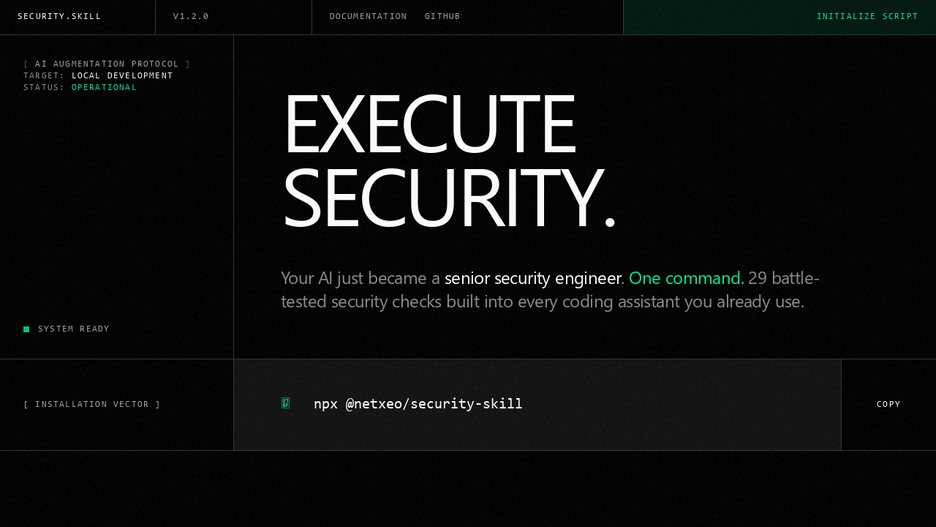
skill-file-security installs a set of security-review skills into an AI coding assistant so it can flag vulnerabilities while code is being written rather than only after the fact. An interactive mode detects the project's stack, such as Next.js, Supabase or Docker, and asks a short series of questions to install only the relevant rules; a fast mode installs everything silently, for a specific assistant or for all detected ones at once.
Once installed, slash commands run a quick scan for critical issues, a full audit that produces a score out of 100 and a report file, an apply-fixes command that asks before touching code, a status command that reads score history from a local memory file, an incident-response playbook, and a plain-language explanation of a given security rule or concept. Its stated coverage spans the OWASP Top 10 and the CWE Top 25, checking for issues such as unsafe buffer allocation, cross-site scripting, SQL injection, path traversal and missing authorization.
It is installed with npx and is written in JavaScript.