

Skill Store
A skill store aggregating official and community AI agent skills across document processing, content creation, programming, machine learning and automated workflows, auto-updated daily.
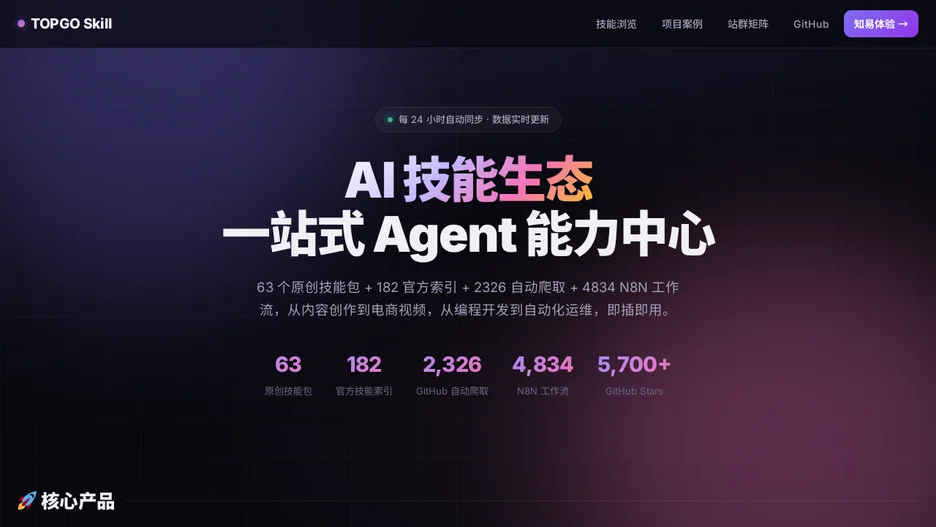
Skill Store is a library of AI agent skills spanning document processing, content creation, programming, machine learning and automated workflows, combining 182 skills automatically crawled from an upstream awesome-agent-skills repository with 63 locally curated skills (27 core plus 30 sub-skills and 6 built into the system), for 245 skills in total, refreshed on a 24-hour automatic crawl with full backup coverage.
Official skills come from teams including Anthropic, Vercel, Cloudflare, Trail of Bits, Hugging Face, Google Labs, Stripe, Supabase, Expo, Sentry and Better Auth, covering areas such as document formats, framework best practices, infrastructure, security auditing, model training and evaluation, and authentication. Locally authored Chinese-language skills cover content creation and publishing (including platform-specific formatting for WeChat and Xiaohongshu), video creation, and e-commerce workflows such as cross-border sourcing and listing automation.
The store organizes skills by function, source and update time, and supports exporting its catalog as JSON or CSV for further analysis.