

Spring AI
A Spring-friendly application framework for AI engineering, providing portable, strongly-typed APIs that connect enterprise data and services to AI models across many providers.
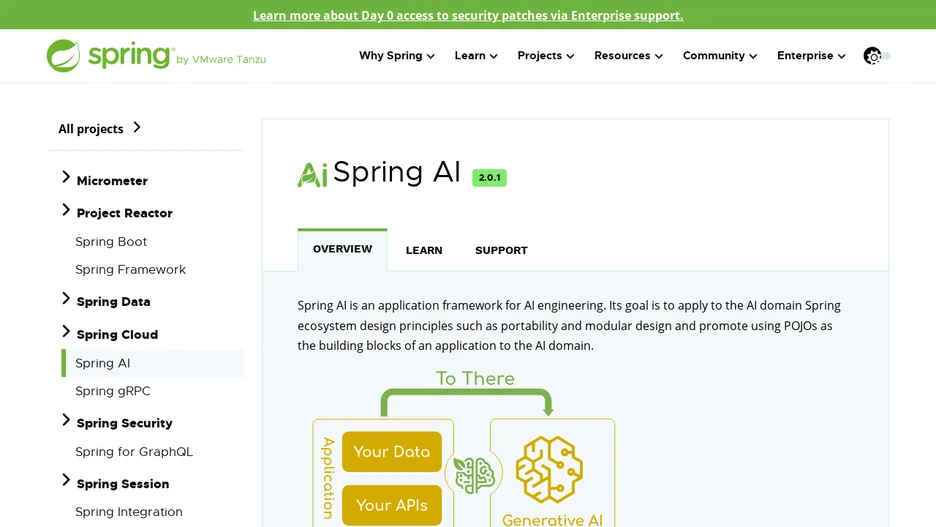
Spring AI provides a Spring-friendly API and set of abstractions for developing AI applications. It applies Spring's own design principles, such as portability and modular design, to the AI domain, using strongly-typed data structures and APIs as the building blocks of an application, to connect enterprise data and APIs with AI models.
It supports major AI model providers, including Anthropic, OpenAI, Amazon Bedrock, Google, Ollama, Mistral AI and DeepSeek, across chat, embedding, text-to-image, audio transcription, text-to-speech and moderation model types, with a portable synchronous and streaming API and access to provider-specific features when needed. Structured output maps a model's response onto plain Java objects, and tool calling lets a model request the execution of client-side tools and functions. It also provides a portable API across more than a dozen vector store providers, including a SQL-like metadata filter API, observability into AI operations, and a document-injection ETL framework.
It is written in Java under the Apache-2.0 license, with Spring AI 2.x targeting Spring Boot 4.x and the 1.1.x branch targeting Spring Boot 3.5.x.