

Sympozium
Sympozium is a coordination layer for multi-agent AI systems on Kubernetes, giving agents shared situational awareness through selective permeability, structured handoffs and shared memory while each agent runs in an isolated workload defined as a Kubernetes CRD.
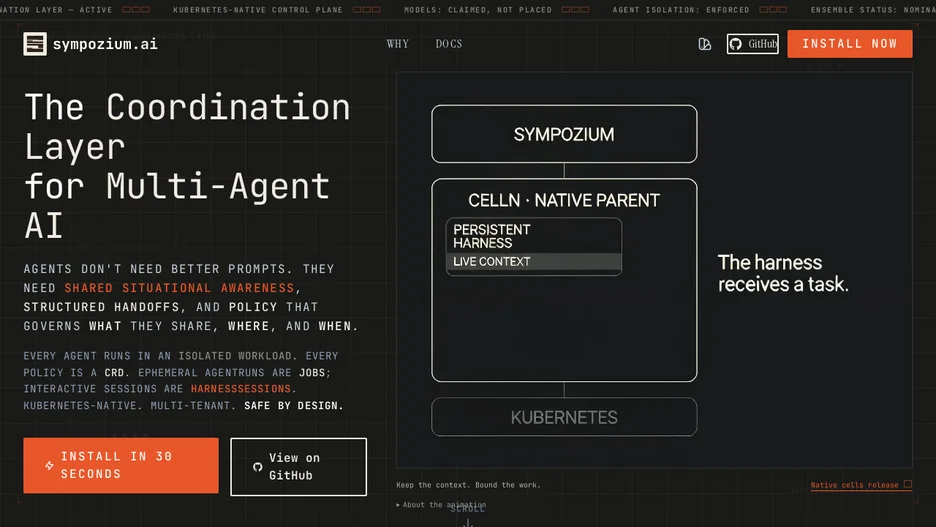
Sympozium runs each agent in its own isolated workload on Kubernetes, using a fleet of microVMs on nodes with KVM support, with every coordination policy expressed as a Kubernetes custom resource. It focuses on giving agents shared situational awareness, rather than better prompts, through structured handoffs and shared memory with selective permeability between agents.
An experimental AgentHarness component runs an administrator-approved external adapter in an isolated AgentRun, or a session-capable runtime for a private, continuing agent-to-chat conversation, while Kubernetes policy, identity, skills, memory, MCP access, observability and audit stay under platform control; this is described as an adapter boundary, not permission to run arbitrary upstream images.
It installs with Homebrew, a shell installer, or a Helm chart that requires cert-manager for webhook TLS, and is written in Go under the MIT license. It is under active development, with an unstable API.