

The Edge Agent
A neurosymbolic AI agent framework that pairs an LLM with Prolog logical reasoning, letting small local models prove their conclusions instead of only generating plausible-sounding text, packaged as a single offline binary.
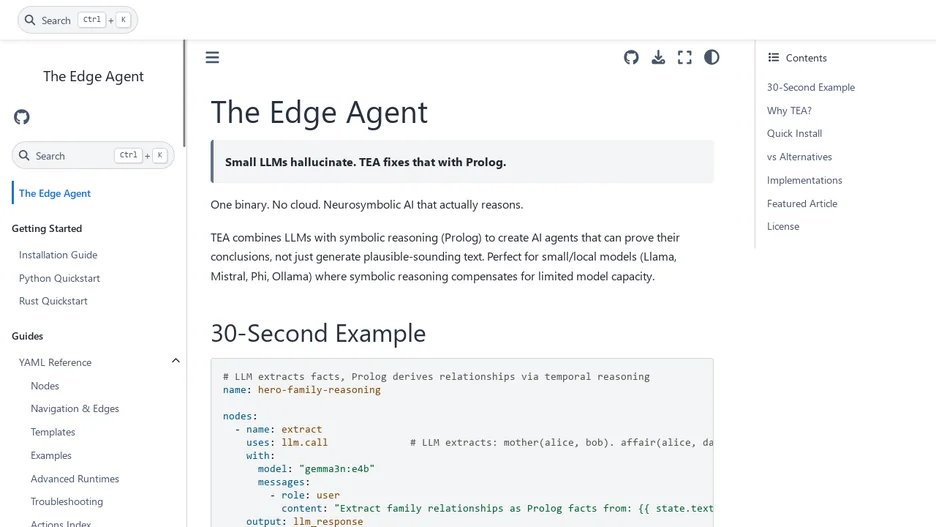
The Edge Agent, or TEA, combines a large language model with Prolog symbolic reasoning so an agent can prove its conclusions rather than only generate text that sounds plausible, aimed particularly at small or local models such as Llama, Mistral or Phi run through Ollama, where symbolic reasoning compensates for limited model capacity. In its documented example, an LLM extracts facts from a short narrative and Prolog then proves a stated relationship, such as a half-sibling connection, from those facts and family-relationship rules.
Workflows are defined in YAML, and the project describes more than 20 built-in actions for LLM calls, retrieval-augmented generation, memory and storage, along with built-in distributed tracing for observability into agent behavior. It runs as a single binary with no external services required, supports running entirely offline using bundled GGUF models, and is available as a Python package with the full feature set or a smaller Rust build for embedded or offline use.
It is licensed under MIT.