

ThinkJEPA
A research framework, released with its NeurIPS 2026 paper, that pairs a vision-language reasoning model with a JEPA-based world model, so high-level semantic reasoning guides low-level physical prediction for embodied, robotic tasks.
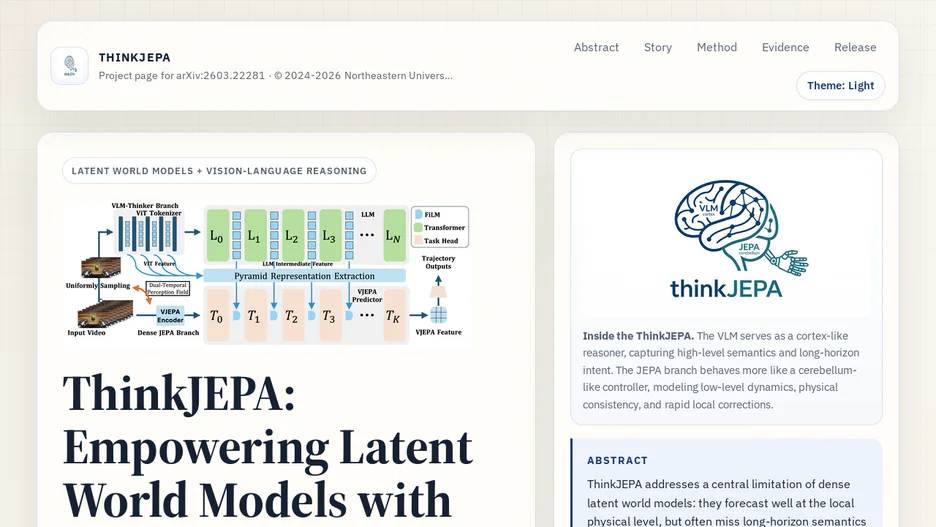
ThinkJEPA is the official code release for a NeurIPS 2026 paper describing a dual-path embodied prediction framework. A vision-language model acts as a higher-level reasoner, providing long-horizon intent and semantic guidance, while a separate JEPA-based branch acts as a lower-level controller that models video dynamics, physical consistency and rapid local correction.
The released training path predicts future trajectories from the JEPA branch's features, conditioned on guidance from the vision-language branch, and is set up to reproduce the paper's training and evaluation on EgoDex-style data and cached inputs. This public release is intentionally minimal, including the core training and evaluation code, preprocessing scripts, retained helpers for the EgoDex dataset, and a bundled V-JEPA2 dependency needed by the released training path, with a documented Python and PyTorch environment for reproducing it.