

UFO³
A multi-device agent framework that decomposes tasks into a dynamic DAG (Galaxy) and coordinates per-device agents (UFO2) across heterogeneous platforms over a unified agent protocol.
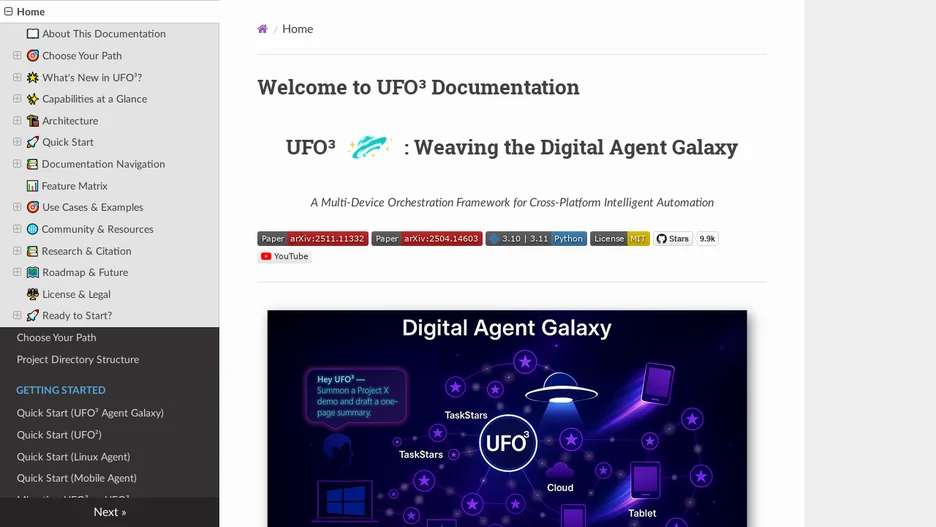
UFO3 is a multi-device agent framework combining two layers: Galaxy, a multi-device orchestration layer, and UFO2, a single-device agent for Windows automation with deep OS integration and hybrid GUI and API actions. UFO2 alone suits single-Windows automation, quick task execution and simple workflows, and can also act as a Galaxy device agent.
Galaxy decomposes a request into a dynamic, structured DAG of tasks with dependencies, which is rewritten at runtime as execution feedback comes in, matching devices to tasks by capability and running them asynchronously with safe locking. Devices communicate over a WebSocket-based Agent Interaction Protocol (AIP) with fault tolerance and automatic reconnection, and device agents are built from templates with Model Context Protocol (MCP) integration for rapid development.
It is written in Python and released under the MIT license.