

Weight Atlas
An interactive canvas for inspecting a large language model's weights tensor by tensor, showing measured INT8, INT4 and FP8 quantization error, spectra and outlier channels for every tensor in a checkpoint.
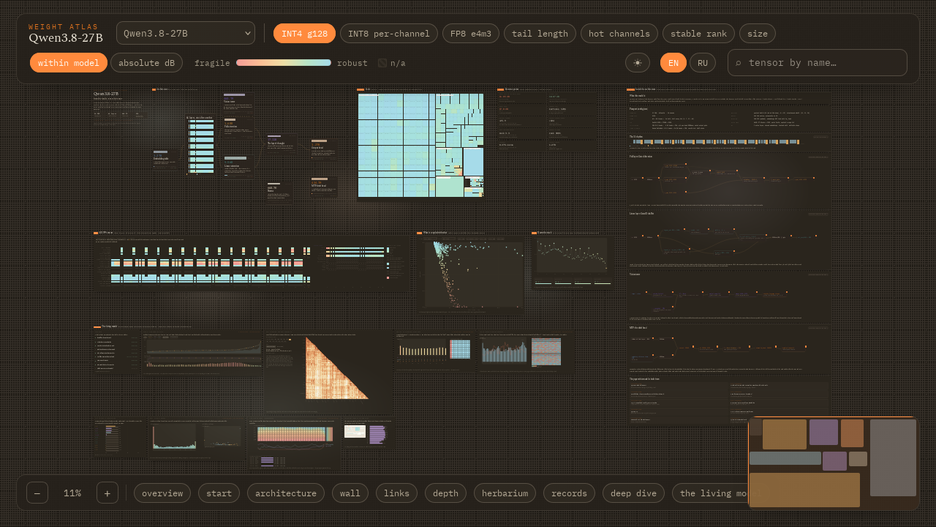
Weight Atlas lays out an entire model checkpoint, read from its safetensors shards, on a single pan-and-zoom canvas, to answer what in the model can be compressed losslessly, what falls apart under compression, and why. Every number shown is measured rather than estimated: each weight tensor is actually quantized and its error computed as SQNR in decibels for three schemes, INT8 per-channel, INT4 group-128 and FP8 e4m3, with spectra from real SVDs, histograms from real bins, and outlier channels from real row and column maxima.
The canvas includes a model overview, an architecture group map from embedding to head, a wall view of every tensor at once, a scatter view for comparing any two metrics, a per-layer depth view, a treemap sized by parameter count, and an architecture teardown. Metrics that do not apply to a tensor render as explicitly marked not applicable rather than a silent zero.
A single Python script scans a checkpoint's shards on one GPU, about two minutes for a 27B model, and writes the results as a file the canvas reads.