

ygrep
A fast, local, indexed code search tool written in Rust for Tantivy full-text indexing, built to be called by AI coding assistants, with a management terminal dashboard and a background indexing service.
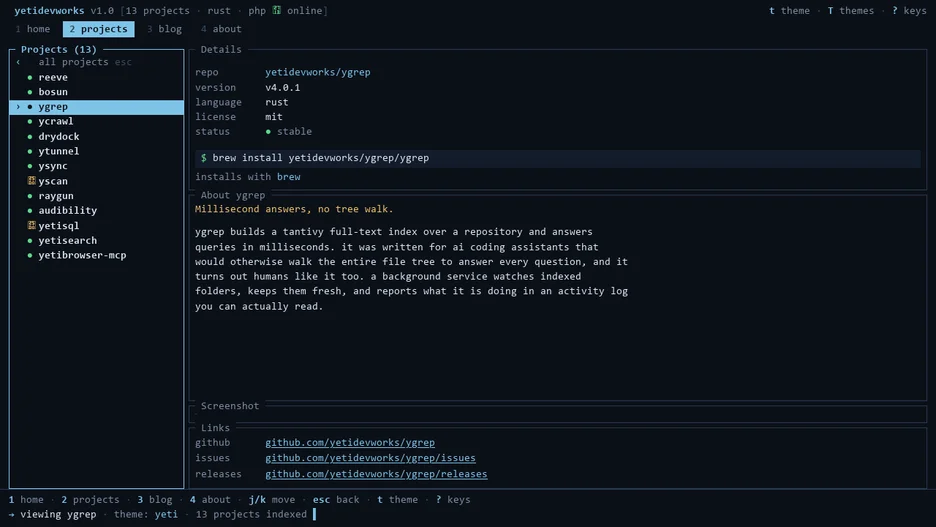
ygrep behaves like grep by default, matching literal text including special characters such as a variable sigil or a decorator, but builds a Tantivy-backed index so repeated searches are instant rather than scanning files each time; a code-aware tokenizer preserves such characters as part of tokens, and splits camelCase and snake_case identifiers into subtokens so a search for one word also finds a longer identifier containing it. Regex search, multi-word AND queries, and filename search are also supported, and an unindexed workspace is indexed automatically the first time it is searched.
Indexing is incremental, based on file modification time, with generated assets skipped and the document store compressed to roughly halve index size; a background service can watch flagged indexes from login without a terminal open, and running ygrep alone in a terminal opens a management dashboard showing every index, the background service, and live activity. An optional semantic search mode adds a local vector index using a small local embedding model.
It is written in Rust, distributed through Homebrew or Cargo, and licensed under MIT.