

Agentic API
A Rust-native, stateful API gateway that sits in front of vLLM and implements an OpenAI-compatible Responses API server-side, so a client makes one call and the server manages conversation state, tool execution and streaming.
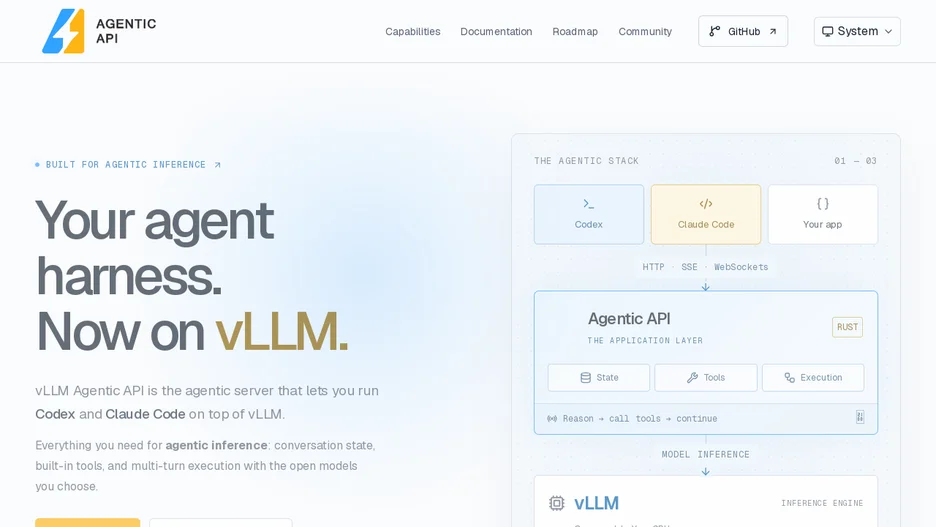
Agentic API is a stateful, agentic API layer for vLLM, written in Rust. Real agentic applications need conversation state, tool-call loops and multi-turn orchestration beyond raw token generation, and this gateway moves that complexity from client code onto the server, starting with an OpenAI-compatible Responses API. vLLM is one supported backend rather than a fixed dependency of the product itself.
The server manages conversation history through a previous-response identifier instead of the client replaying full transcripts, executes tools server-side under an explicit ownership model that decides whether the gateway, the client or the provider runs a given tool, and supports non-streaming HTTP, server-sent events and full WebSocket transports. It accepts Codex-shaped Responses traffic out of the box, including its tool declarations and response item shapes, so OpenAI Codex can be pointed at open models served by vLLM with no OpenAI account required.
It also supports fire-and-forget background execution, and is validated against the Open Responses compatibility suite with replay-cassette tests against real OpenAI and vLLM traffic.