

Agentic-RAG-with-LangGraph-and-Ollama
Notebook code for building production-oriented retrieval-augmented generation systems with LangGraph orchestration and local Ollama models, aimed at keeping document data and inference on the developer's own machine.
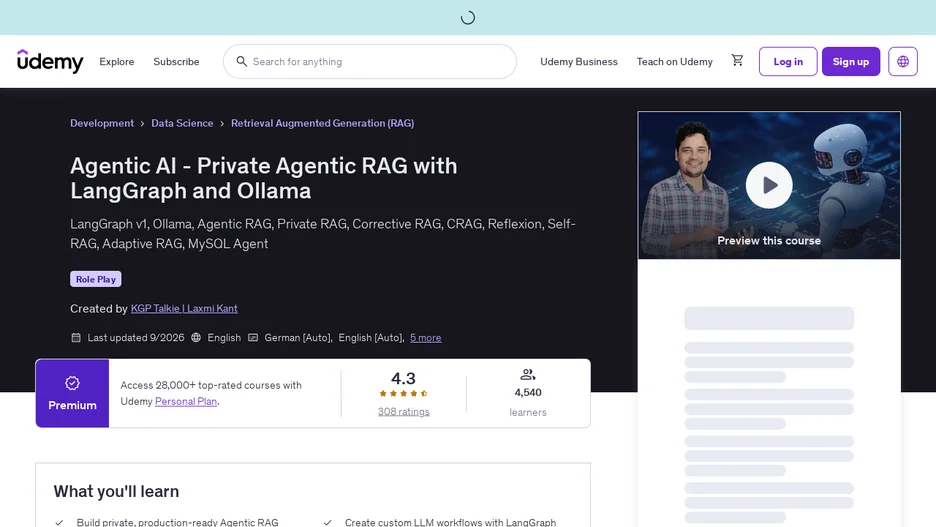
This repository provides Jupyter notebooks for building agentic retrieval-augmented generation systems using LangGraph for orchestration and Ollama for running language models locally rather than through a cloud API, so the underlying data stays private. Its stated focus is techniques such as corrective RAG, where the pipeline can detect and correct its own retrieval errors, alongside document processing and vector-based retrieval.
The material also references locally runnable open-weight models, including DeepSeek R1, Qwen and Llama, and a FAISS vector database for storage and search, and demonstrates a Streamlit front end for interacting with the resulting pipeline.
It is written primarily as Jupyter Notebooks, and no license is asserted in its repository metadata.