

ArcRift
A local-first memory layer that captures conversations from browser AI chats such as Claude or ChatGPT and from MCP-connected coding tools such as Cursor, builds a searchable local knowledge graph, and injects relevant context into new prompts either way.
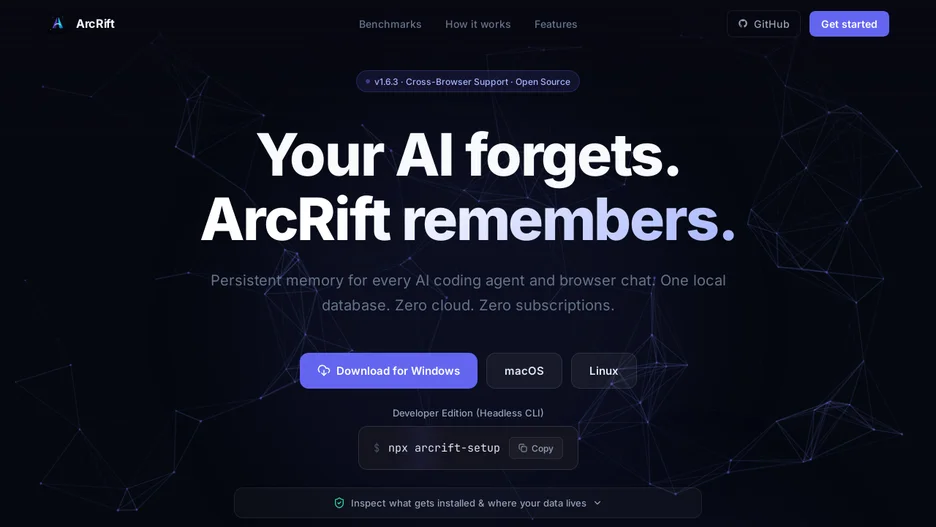
ArcRift installs as a browser extension that captures conversations from Claude, ChatGPT, Gemini, DeepSeek, Grok, Copilot or Mistral, and as a native MCP server that connects to coding tools such as Claude Code, Cursor, Windsurf or Claude Desktop. It extracts structured facts from captured conversations into a local SQLite-backed knowledge graph, embeds them as searchable vectors, and automatically prepends the most relevant context to a new prompt in whichever tool the user is working in, so context from a browser chat is available in an IDE agent and vice versa.
It runs entirely on the user's own machine, with no cloud service or subscription, and installs with a single setup command. The project has been rebranded from two earlier names, and installing it requires Node.js and, for local model features, Ollama already installed.