

AutoBot
A self-hosted AI platform with a small core (RAG plus knowledge-graph memory, a provider-agnostic LLM gateway with fallback, and governance), a lifecycle manager that deploys, operates and scales the underlying infrastructure, and installable modules built on top.
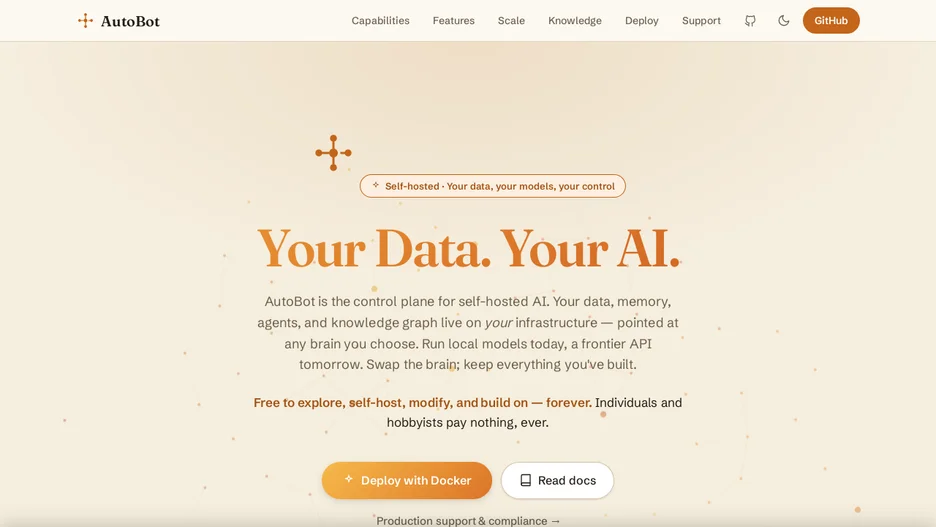
AutoBot is a self-hosted AI platform meant to be owned rather than rented: users feed it their documents, codebase and business knowledge, connect any LLM they trust, local or hosted, and their data and prompts stay on their own infrastructure. It ships a chat interface, a RAG knowledge base, service-lifecycle management and a module ecosystem, with no subscription.
A small, stable Platform Core handles chat and streaming, a RAG knowledge base backed by a knowledge graph as institutional memory, an LLM gateway with provider fallback and local inference, hooks, and governance such as auth, role-based access control, review gates and budgets. A Service Lifecycle Manager owns deploying, operating and scaling the surrounding infrastructure, such as the vector database, cache, database, inference and background workers, often across several machines, so operators do not have to run it by hand. Installable Modules build capabilities on top of the core and inherit its institutional memory, local inference, hooks and governance instead of rebuilding them.
Apache-2.0 licensed; built with Python.