

AutoMem
A long-term memory service for AI assistants that combines a graph database of typed relationships with a vector index, so an assistant can recall the reasoning behind a decision rather than only similar past text.
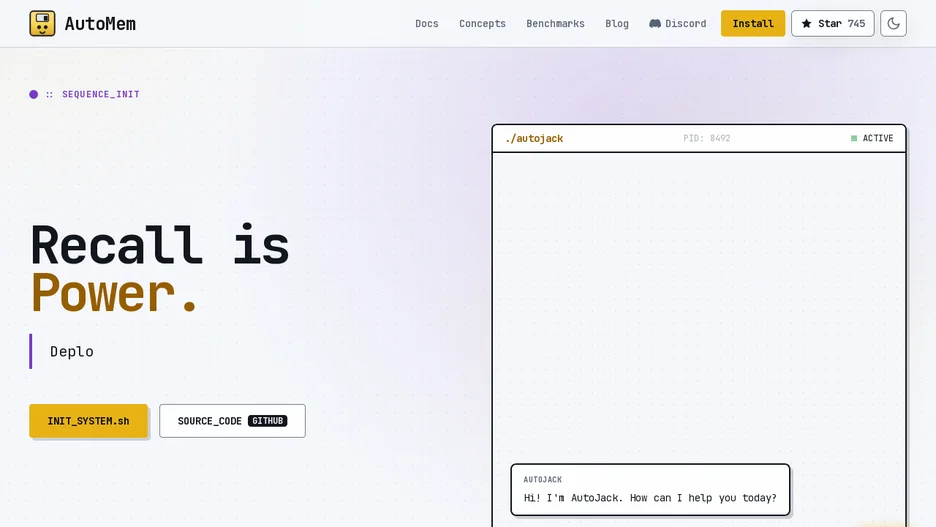
AutoMem gives an AI assistant a memory that persists across sessions. It stores the decisions, preferences, notes and context a user wants recalled, so tools such as Claude, Cursor, Codex or ChatGPT can retrieve the right detail later instead of the conversation starting over each time.
It combines two storage layers: FalkorDB holds memories as graph nodes with eleven typed relationships between them, so a decision, its rationale and its consequences can be followed as connected facts rather than only matched by similarity; Qdrant provides the vector index used for semantic lookup. Retrieval runs directly against these stores without an extra generation call in the middle, using embeddings from Voyage, OpenAI or a local provider.
It runs locally with Docker, on a user's own infrastructure, or as a small hosted service group, and exposes both an MCP bridge for desktop and CLI clients and a REST API for cloud agents.