

Captain Claw
A self-hosted, model-agnostic framework for orchestrating fleets of specialist AI agents, offering six ensemble-reasoning modes and a separate plan-build-review pipeline for shipping code.
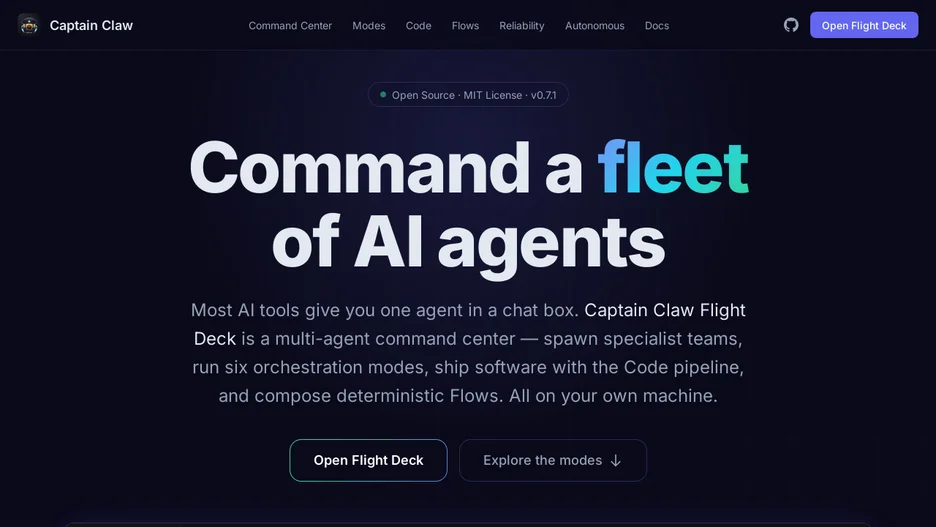
Captain Claw's Flight Deck spawns teams of specialist AI agents and runs them under six different orchestration modes, backed by 48 built-in tools per agent, several shared memory layers, and a library of ready-made specialist agents. It connects to OpenAI, Anthropic, Google Gemini, DeepSeek, Ollama or OpenRouter, including a sign-in option that needs no separate API key, or it can run entirely on local models through Ollama.
Its Code feature splits software delivery across independent agents rather than one agent that plans, writes, reviews and tests in a single context: a router sizes the job, then runs a plan, an approval step, a build, three independent reviewers in parallel, a triage step, and a capped fix loop, with every phase committed to the project's own git repository and the whole run exported as one auditable Markdown transcript. It can work on fresh folders or existing local repositories, mixing a cheaper model for implementation with a stronger one for review.
It is self-hosted, written in Python, and MIT licensed.