

Caura
Open-source, governed shared memory for multi-agent, multi-tenant AI fleets, with trust tiers, audit trails, a knowledge graph and self-improving retrieval, formerly named MemClaw.
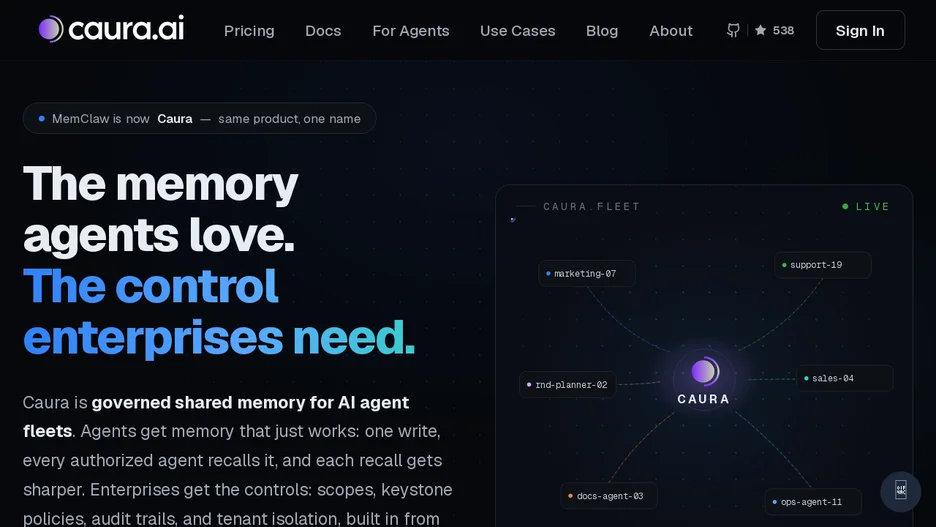
Caura, formerly named MemClaw, is open-source shared memory built for fleets of AI agents rather than a single chatbot. Agents write plain text and Caura turns it into searchable, governed, self-improving memory, a write, recall and compound loop where every interaction can make later ones better informed. It reports production use at a public company with more than 300 agents sharing one governed memory store.
It is designed to scale with the number of agents rather than only the length of a single conversation, adding scoped memory, cross-agent outcome sharing, and fleet-wide trust tiers that keep paying off as more agents are added, in contrast to common agent-memory benchmarks that measure only a single agent's long conversation.
It can run standalone, single-tenant, with authentication bypassed and no API key, for local evaluation, and supports self-hosting with an added AI provider key for semantic search. It is Apache 2.0 licensed and exposes an MCP interface alongside its API.