

Cogniflow AI
A browser-based retrieval-augmented generation app that answers questions over YouTube videos, podcasts and PDFs, with every claim in the answer carrying a citation that deep-links back to the source, built with Next.js and Gemini.
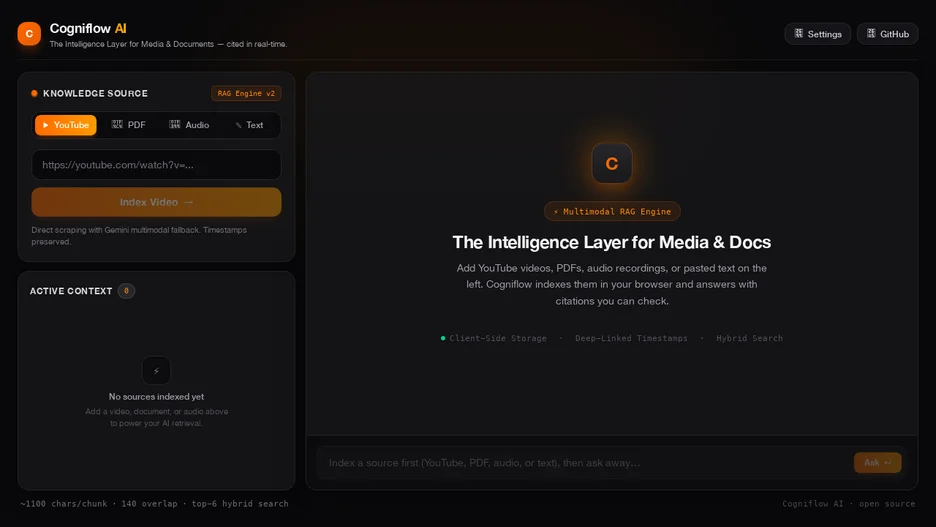
Cogniflow AI lets a user add YouTube videos, podcasts, PDFs or pasted notes as sources and then ask questions against them, with every answer required to ground its claims in numbered citation chips that link back to the source and, for YouTube, to the exact second in the video. PDFs are parsed in the browser and never uploaded, and sources, chunks and embeddings are stored locally in IndexedDB, with only small excerpts sent to the model at question time.
Retrieval combines paragraph-aware chunking with task-typed Gemini embeddings and hybrid vector-plus-BM25 search merged by reciprocal rank fusion, and follow-up questions are rewritten into standalone queries before searching again. If the added sources do not contain an answer, the model says so rather than falling back on its own outside knowledge.