

Dagu
A self-hostable, single-binary workflow engine for operations and internal automation, defining DAGs in declarative YAML with scheduling, retries, human tasks, and a built-in web UI.
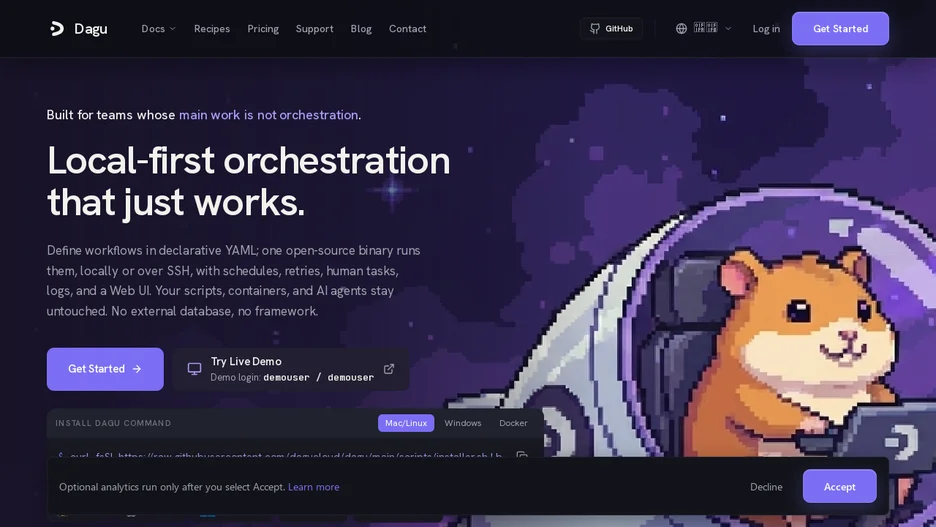
Dagu is a local-first workflow engine for operations and internal automation. It is open source and self-hostable as a single binary with a built-in web UI, no external database or message broker, running on Linux, macOS, and Windows, and natively supports running shell commands, Docker containers, Kubernetes jobs, and remote commands over SSH.
It turns existing scripts and runbooks into production workflows with scheduling, retries, human tasks, and run history, running on-prem, air-gapped, at the edge, or in the cloud, and scaling from a single node to a fleet of workers. DAGs are defined in a declarative YAML format, reusable sub-DAGs can be composed and run in parallel with concurrency controls, and cron-style schedules support timezones, overlap policies, and catch-up windows. A built-in MCP server can inspect workflows and runs, maintain wiki pages, apply changes, and control runs, positioning Dagu as a lighter alternative to Airflow, cron, or other job schedulers for teams whose main job is not orchestration.