

Dunetrace
A runtime reliability layer for AI agents that runs deterministic, zero-model checks on every run to catch silent failures such as circular delegation, and can block an action before it executes.
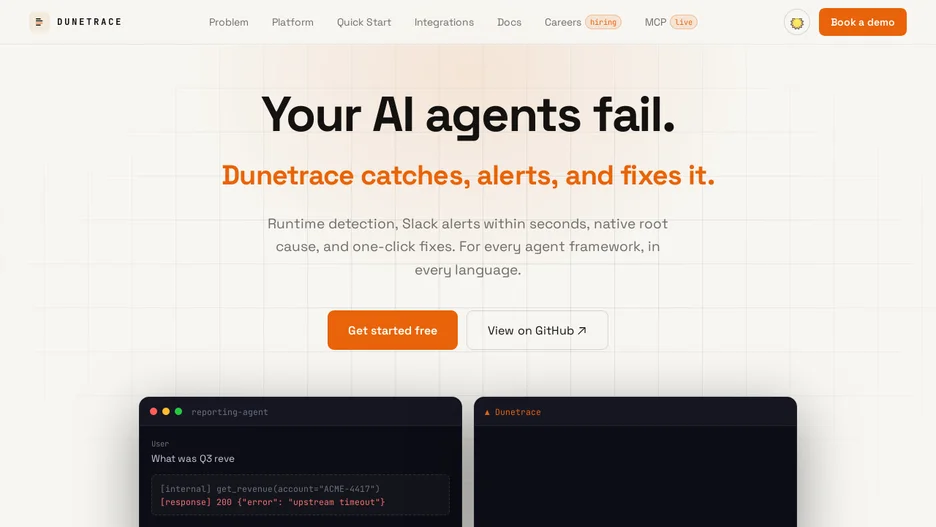
Dunetrace targets a specific failure mode of AI agents: an agent can report success with a normal-looking API response and normal cost and latency while still having invented a result or gotten stuck in a loop with another agent. Where a tracer only explains what happened after a failure is already known, Dunetrace runs zero-model structural detectors in the request path, fast enough to run on every call, alongside slower, sampling-based semantic checks such as hallucination or task-completion judgments made by a model.
Its five components cover recording every run, event and tool call; structural detection; semantic evaluation; runtime policies that can stop, redirect or downgrade a run while it is happening; and root-cause analysis with suggested or automatically applied fixes. It runs as a self-hosted backend started with Docker Compose, with Python and Node.js SDKs to instrument an agent, and a setup skill that can install and wire up the SDK inside Claude Code or Codex.