

emem
A shared, content-addressed and cryptographically signed external memory store that lets independent AI agents cite and verify the same real-world observation, such as a satellite image or a camera record, without sharing a model or a vendor.
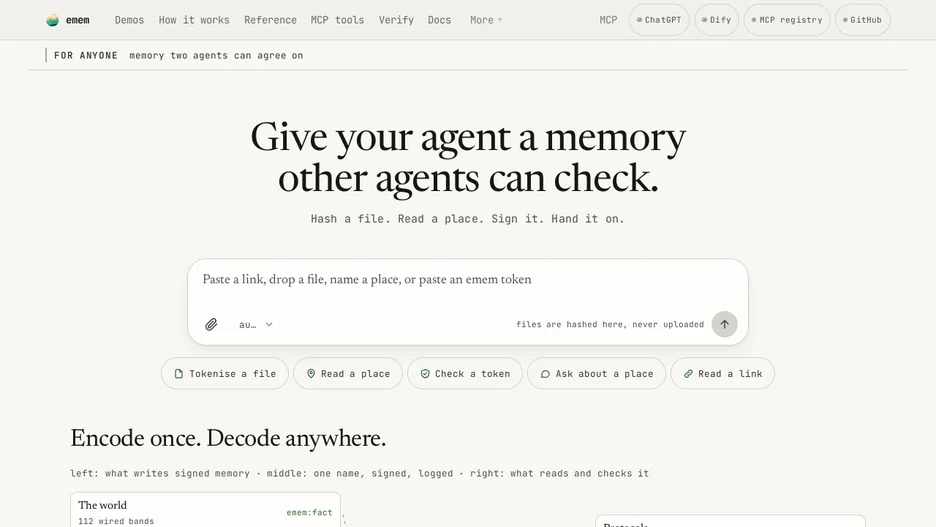
emem stores observations of the physical world, such as satellite imagery and camera evidence, as content-addressed, signed records rather than as text an agent can only paraphrase. A token identifies the address of a piece of evidence rather than carrying the payload itself, so requesting the same fact repeatedly returns the same signed bytes instead of a fresh, possibly inconsistent answer the way a language model would, and different agents citing the same address can each verify it independently.
The project positions this as infrastructure for agents doing research together: one agent's observation becomes another agent's starting point, findings accumulate around evidence that later agents can inspect, and a signed reference can be carried through a handoff between models or recovered after a session ends, reducing referential drift and compaction failures compared with passing raw text between agents.
It is written in Rust and licensed under Apache-2.0, using content addressing, Ed25519 signatures and a transparency log.