

Faramesh
A local governance daemon for AI agents that enforces declarative tool-call policies deterministically before each call runs, with identity-bound credentials and a tamper-evident audit log.
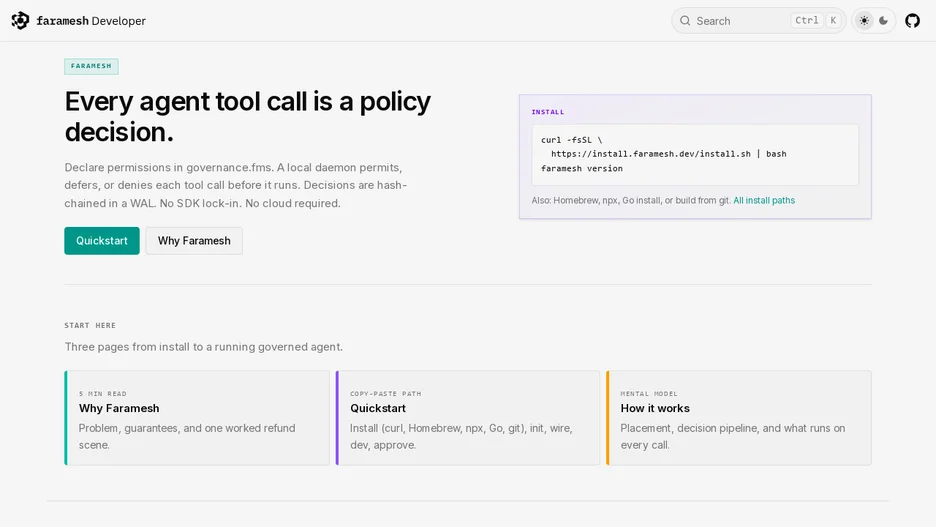
Faramesh is governance-as-code for AI agents: permissions are declared in a policy file, and a local daemon permits, defers or denies each tool call before it executes, based on pure functions over the policy and the action's payload rather than another model call in the decision path. Every decision is hash-chained in a write-ahead log for a tamper-evident audit trail.
It integrates with thirteen agent frameworks and tools, including LangGraph, LangChain, CrewAI, OpenAI Agents, the Claude Agents SDK, Claude Code, Cursor, MCP, AutoGen, AG2, LlamaIndex, Pydantic AI and Semantic Kernel, connecting through an SDK shim, an MCP proxy, an HTTP proxy or the Agent2Agent protocol depending on the framework. Credentials are brokered at the call site and bound to an identity through SPIFFE SVIDs, OIDC or a cloud workload identity, and example policies cover cases such as routing external emails to a human, requiring a click to confirm a cancellation, making deletion impossible without editing the policy, and enforcing a daily spending ceiling.
It installs with a shell script, Homebrew, npx or a Go install, or by building from source, and is distributed under the Apache-2.0 license.