

Gensee Crate
An open-source safety layer for autonomous AI agents that groups background activity by originating request, surfaces scope drift and failed verification for review, lets a user set per-tool allow, ask or block policy, and creates recovery points.
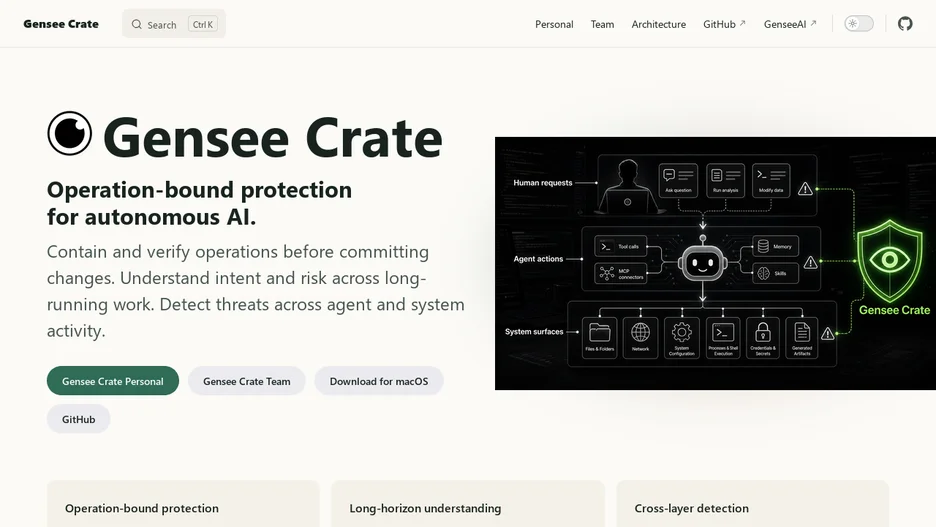
Gensee Crate is a safety and control layer for autonomous AI agent work, meant to keep routine agent activity quiet while surfacing the activity that needs a human decision. A review queue groups background activity with the request that started it and highlights scope drift, blocked actions, approval requests and failed verification, while routine activity stays in history; local policy can allow, ask about, or block supported tool actions and protect sensitive paths, and explicitly approved actions or trusted file and folder reads can be remembered to reduce repeated interruptions without silently widening what is granted.
A Personal edition creates recovery points for supported Git-workspace changes on a single Mac; a Team edition adds disposable, isolated Linux workspace forks that can be inspected, merged, promoted or discarded, and scoped authority across a self-hosted environment. Preliminary results on the AgentCanary benchmark are reported as improving defense rate against memory-poisoning, long-horizon and prompt-injection threats with low runtime overhead.
Current integrations for the Personal macOS app and CLI include Codex, Claude Code, Cursor, GitHub Copilot and Antigravity.