

German-OCR
A vision-language model fine-tuned specifically to extract structured text from German business documents such as invoices, receipts, and forms, runnable locally or through a cloud API.
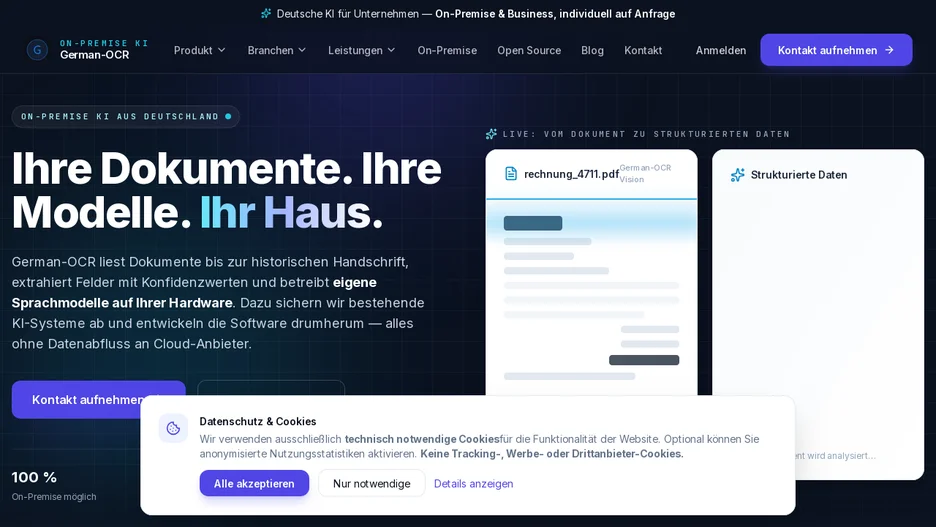
German-OCR is a document AI system fine-tuned on Qwen models specifically for German documents, offering two specialized models: a vision-OCR model that turns a document image into strict JSON, and a text-assistant model for translating, summarizing, rewriting, or chatting about the extracted text. It supports Hugging Face, Ollama, and llama.cpp as local backends, alongside a hosted, EU-based cloud API for both synchronous and asynchronous processing.
Local processing keeps documents entirely on the user's machine and takes a few seconds per page on supported hardware, including CPU, GPU, and NPU backends across CUDA, Metal, Vulkan, and OpenVINO, while the cloud versions add features such as processing up to fifty pages per PDF and, in a newer version, synchronous structured field extraction.
It installs as a Python, Node.js, or PHP package, and is released under the Apache-2.0 license.