

GFM-RAG
A graph foundation model-powered retrieval-augmented generation pipeline that uses a pre-trained graph neural network to reason over a knowledge graph built from a user's documents and retrieve passages for question answering.
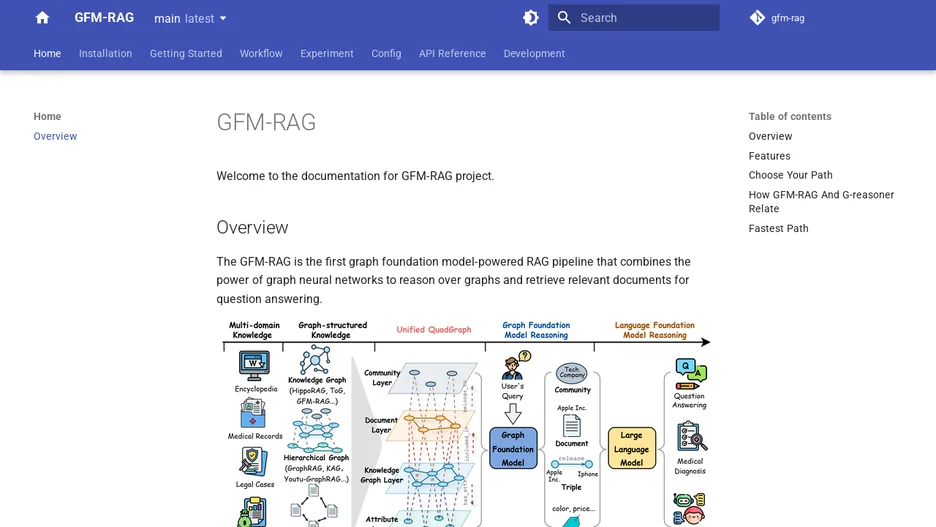
GFM-RAG is a graph foundation model-powered RAG pipeline that combines a graph neural network's ability to reason over graphs with retrieval of relevant documents for question answering.
A graph index is built from a set of documents to capture relationships between pieces of knowledge; the query and that graph index are then fed into a pre-trained graph foundation model retriever to find relevant documents for an LLM to generate from. The retriever was trained at large scale and can be applied directly to a new, unseen dataset without fine-tuning, or fine-tuned further to improve performance in a specific domain. Its universal graph index can represent knowledge graphs, document graphs or hierarchical graphs, and it performs multi-hop reasoning with a single retrieval step.
It is compatible with arbitrary agent-based RAG pipelines, and its companion project, G-reasoner, extends the same graph-based foundation model approach to broader reasoning over graph-structured knowledge.