

GibRAM
An in-memory knowledge graph server for retrieval-augmented generation that stores entities, relationships and document chunks together with their embeddings so related information stays connected during retrieval.
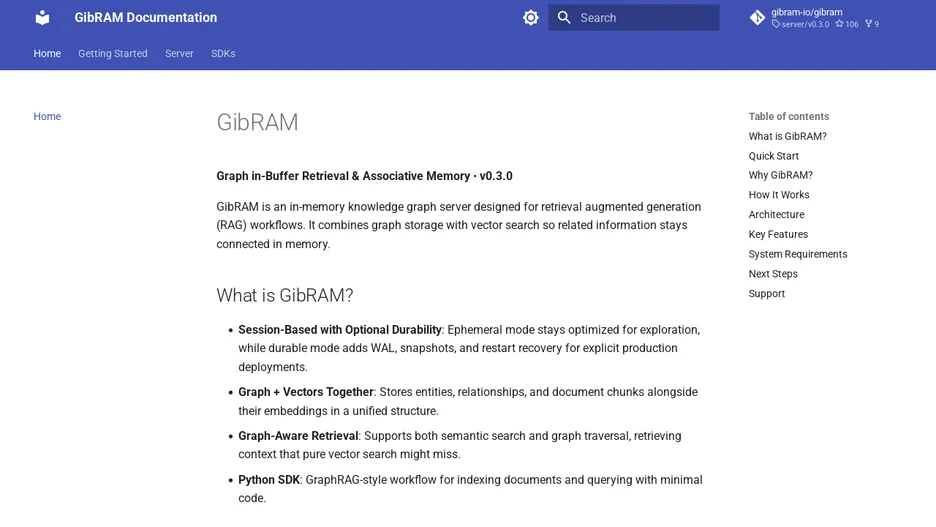
GibRAM is an in-memory knowledge graph server for retrieval-augmented generation (RAG) workflows. It combines a lightweight graph store with vector search, so that entities, relationships and the text chunks that mention them stay linked in the same structure, making it easier to retrieve related items when a query names a specific subject.
Data lives in RAM with a configurable time to live, so GibRAM is meant for short-lived analysis and exploration rather than persistent storage. Retrieval can traverse entities and relationships as well as run semantic vector search, pulling in context that similarity search alone would miss. A Python SDK provides a GraphRAG-style workflow for indexing documents and running queries with minimal code, and its chunker, extractor and embedder components can each be swapped out.
It installs from a shell script or as a Docker image, defaults to serving on one port, and also installs as a Python package.