

Graphiti
An open-source framework for building temporal knowledge graphs for AI agents, where each stored fact carries a validity window recording when it became true and when it was superseded.
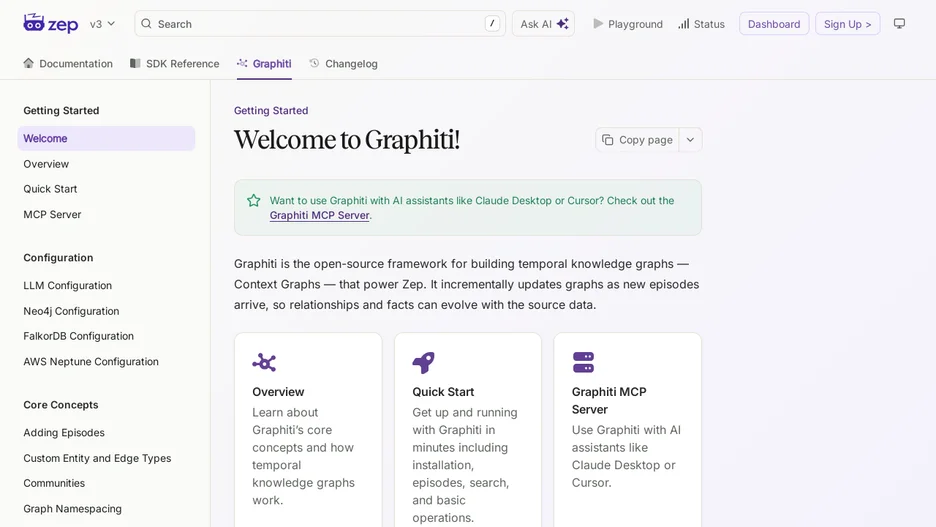
Graphiti builds context graphs out of entities, facts and relationships, continuously integrating user interactions and both structured and unstructured data into a graph that can be queried without a full recomputation, unlike static knowledge graphs or plain retrieval-augmented generation. Every derived fact traces back to the raw "episode" data it came from, entity summaries update over time, and developers can define custom entity and edge types through Pydantic models.
It supports hybrid retrieval combining semantic search, keyword search and graph traversal, so an application can query across time, meaning and relationships rather than flat document chunks or raw event streams. Graphiti is the open-source framework underlying Zep, a separate, proprietary managed service that runs context graphs at scale for production deployments using its own graph database engine.
It is written in Python and licensed under Apache-2.0.