

herdr
A terminal multiplexer built as a runtime for coding agents, keeping their sessions alive in a background server across disconnects and marking every pane as working, blocked or idle.
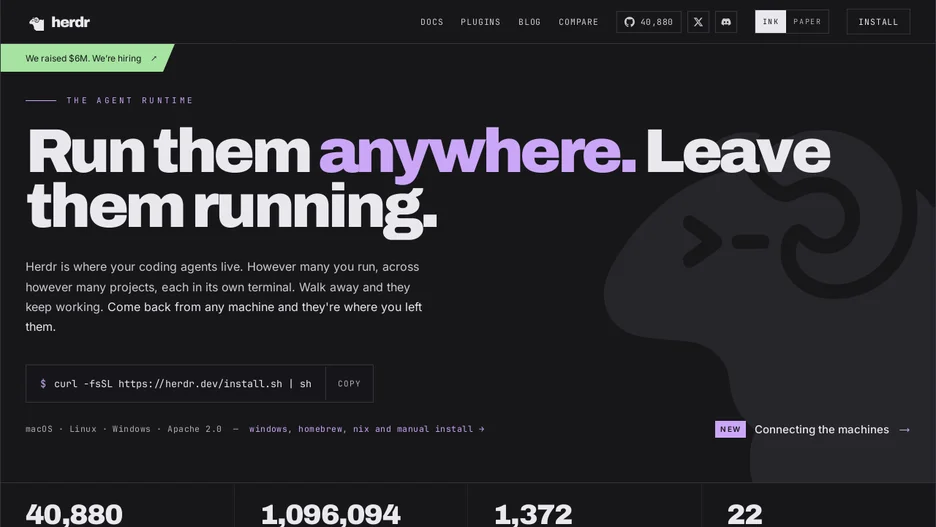
herdr keeps terminals running in a background server so a session survives when its client closes or an SSH connection drops. After a server or machine restart, it restores the saved pane layout and can resume supported agent sessions, though the original processes themselves do not survive the restart. It brings local work and saved SSH machines together in one window with a combined list of agents and independent reconnects, and marks every pane as working, blocked or idle so a stuck agent waiting on an answer is easy to find.
Agents can drive herdr themselves through a CLI and a socket API: spawning panes, prompting each other, and waiting until another agent is genuinely blocked. It runs whatever coding agent is already installed, including Claude Code, Codex, Cursor and OpenCode, without wrapping or replacing them, supports both tmux-style prefix keys and mouse-driven click, drag and split, and can be extended with plugins from a marketplace.
It ships as a single Rust binary with no Electron dependency and is licensed under the Apache License 2.0.