

HippoRAG
A memory framework for LLMs, inspired by human long-term memory, that indexes documents as a knowledge graph so agents can retrieve across multiple hops and integrate new knowledge continually.
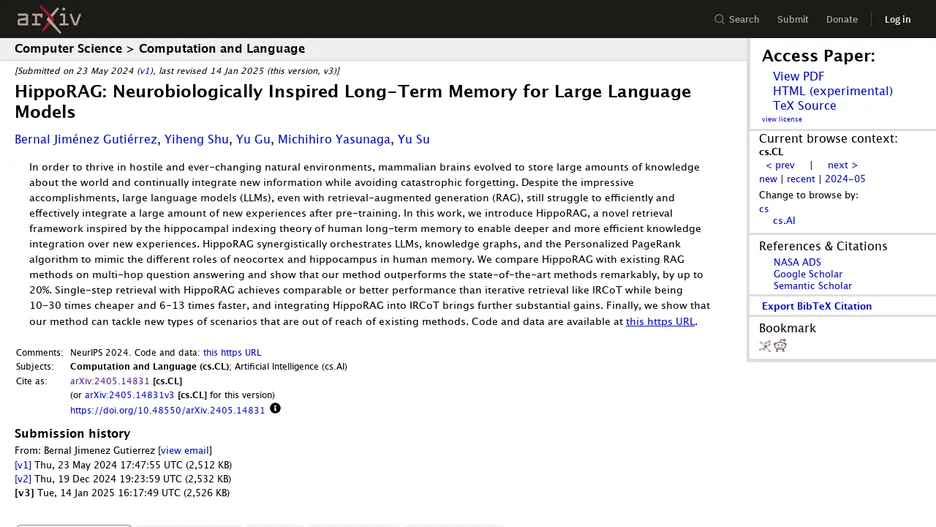
HippoRAG 2 is a memory framework for large language models that recognizes and uses connections between pieces of new knowledge, in a way inspired by a function of human long-term memory. It targets factual recall, sense-making across large and complex contexts, and multi-hop associative retrieval, without giving up performance on simpler retrieval tasks.
It stays efficient for online querying while using fewer resources than other graph-based retrieval approaches, such as GraphRAG, RAPTOR and LightRAG, during offline indexing. It builds an index over documents combining retrieval-augmented generation with a knowledge graph and a personalized ranking step, and can be configured to use different language and embedding models, including local models through vLLM.
It installs as a Python package and its methods are described in papers accepted at NeurIPS 2024 and ICML 2025.