

Kash
A Go command-line tool that compiles a folder of PDFs, Markdown and text files into a self-contained GraphRAG agent packaged as a single Docker container, with an embedded vector store, graph database and keyword index instead of a hosted service stack.
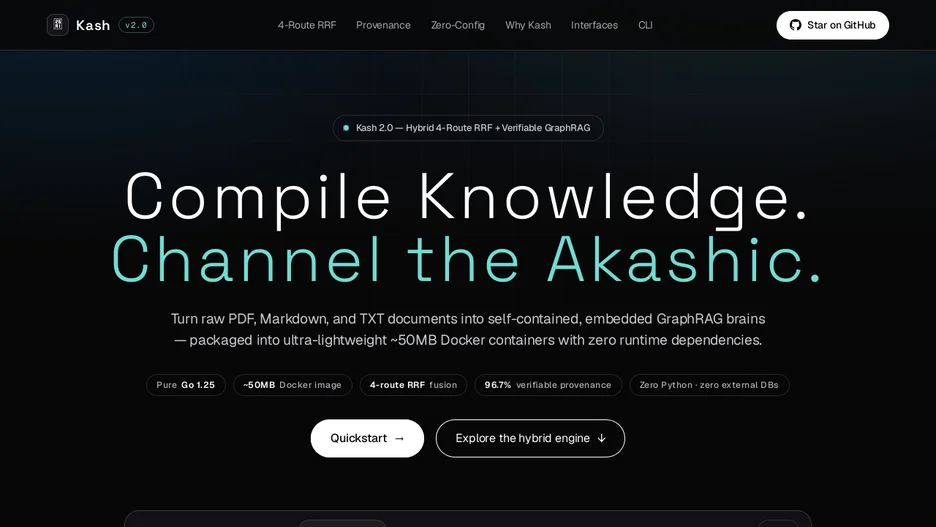
Kash treats retrieval-augmented generation as a compile step rather than a running service: a kash build command turns a folder of documents into one artifact with the vector database (chromem-go), graph database (cayley) and BM25 keyword search all embedded in a single roughly 50 MB Go binary, instead of the usual Python service plus hosted vector database plus graph server plus glue code. The resulting agent runs with kash serve and exposes a REST API, an MCP server and a dashboard on localhost, and can be shared with a plain docker run.
Retrieval runs four independent routes in parallel - vector similarity, BM25 keyword matching, exact structural references such as section numbers, and graph traversal - and fuses their ranked results with Reciprocal Rank Fusion, so a query that misses one route can still be found by another. It works with any OpenAI-compatible API, including OpenAI, Voyage, Ollama, LiteLLM and OneAPI.
Installation is a single go install command, followed by scaffolding a new agent, adding documents and building the index.